Scaling to hundreds of articles exposes every weak point in your tool stack. Some autoposting platforms cap bulk runs, skip semantic analysis, or bury credit rollover rules in fine print, and you only notice after your publishing calendar collapses.
This article walks through seven mistakes to avoid when choosing an AutoPost alternative, from missing SERP analysis to vague pricing and thin provider track records. You will also see how Autoblogging.ai handles bulk generation, editing workflows, and language coverage, so you can decide whether it fits your scaling plan.
What Is Autoblogging.ai?
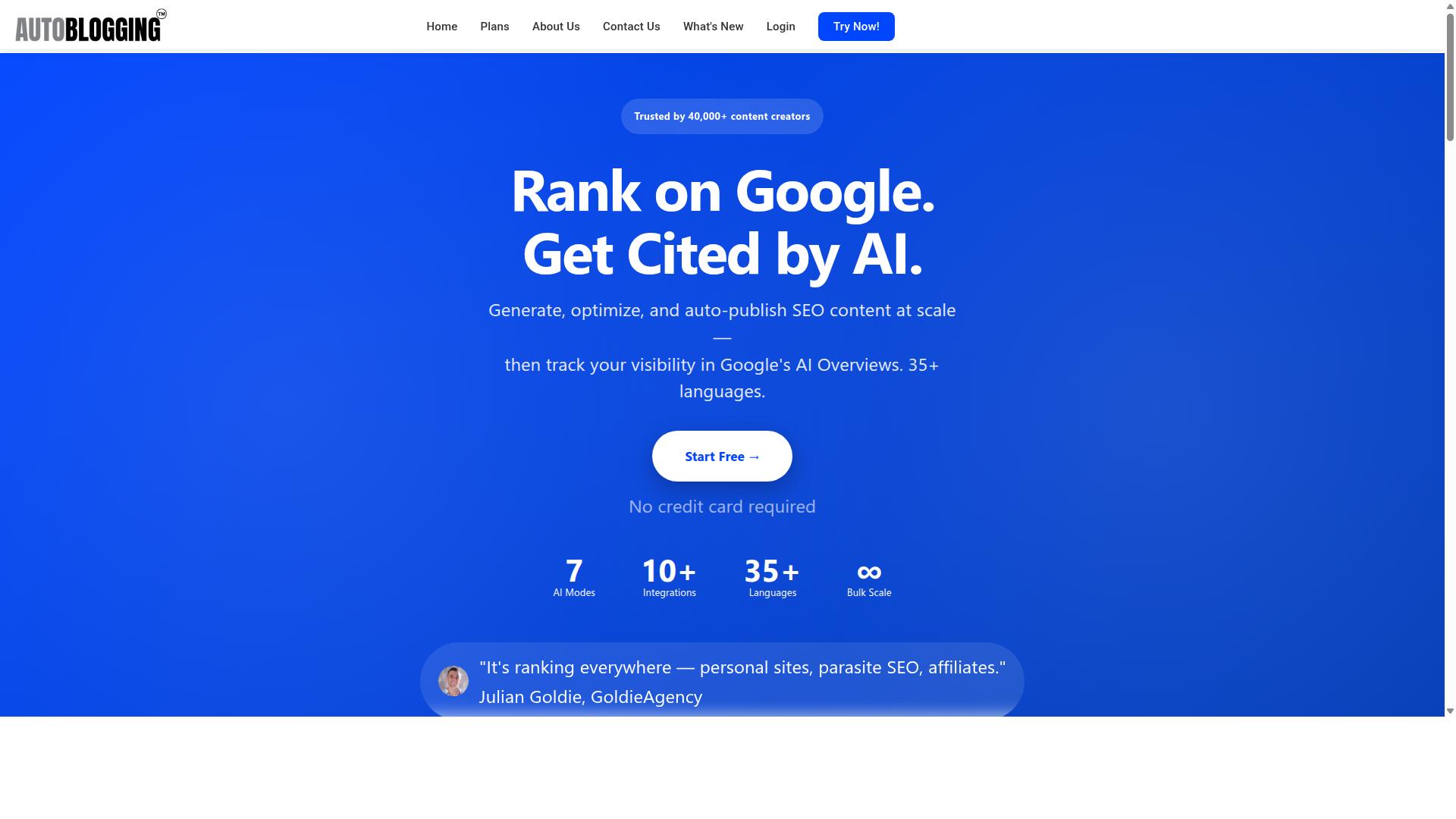
Autoblogging.ai is an AI-powered content generation platform that automates article creation, scheduling, and publishing for bloggers, agencies, and SEO professionals. It is built to take the repetitive manual work out of producing content at volume, so site owners can focus on strategy instead of drafting every post by hand.
Autoblogging.ai is a product of Digimetriq.com. Its stated mission is to help bloggers, website owners, and agencies save time and improve their online presence through cutting-edge technology. That mission shapes everything the platform is designed to do.
A key part of its purpose is cost reduction. Autoblogging.ai aims to cut down content costs and give the power to human counterparts within standard operating procedures by producing the first draft. Digimetriq's broader aim is to replace human counterparts entirely, which signals how far the company intends to push automation.
In a content scaling workflow, this matters because volume is usually the bottleneck. Generating, scheduling, and publishing articles manually does not keep pace with the demands of a growing site or a multi-client portfolio. A platform built around AI content generation addresses that gap directly.
This section stays at the high level: what the platform is and where it fits. The next part looks at who actually uses it and how it slots into real scaling workflows.
Who Autoblogging.ai Serves and How It Fits Scaling Workflows
Autoblogging.ai is designed for bloggers, website owners, SEO professionals, marketing agencies, content creators, and affiliate marketers who need to scale content production efficiently. These are people and teams for whom publishing frequency directly affects visibility and revenue.
The platform serves a wide range of site types, which says a lot about how flexible it is in practice:
- Personal sites
- Parasite SEO
- Affiliate sites
- Client websites
- Portfolio sites
- Local sites
Each of these has a different reason to scale. An affiliate marketer needs a steady flow of pages targeting buying intent. An agency managing client websites needs output that keeps every account moving without hiring a large writing team. A local site owner may simply need consistent posts to stay active in search.
What ties these use cases together is the automation itself. Autoblogging.ai handles content creation, scheduling, and publishing, which removes the manual handoffs that slow most scaling efforts down. Instead of writing, queuing, and posting each article one at a time, the workflow runs with far less human input.
That reduction in manual effort is where the time savings come from. When scheduling and publishing are handled by the platform, teams avoid the bottlenecks that appear once output targets rise. The result is a more consistent publishing rhythm and a stronger online presence over time.
For agencies in particular, this changes the economics of serving more clients. The verified aim of cutting content costs and supporting human workflows with a first draft means teams can take on more sites without proportionally more overhead. Digimetriq's stated goal of eventually replacing human counterparts entirely points to how central automation is to the product's direction.
Understanding this audience and workflow is the foundation for what follows. The mistakes covered in this article tend to surface when scaling happens without a clear view of who the tool serves and how it should fit into your process.
Are AutoPost Alternatives Like Autoblogging.ai Safe and Worth It?
Evaluating the safety and value of AutoPost alternatives like Autoblogging.ai requires examining content quality, SEO compliance, and provider reliability. These three factors separate tools that support sustainable content scaling from those that quietly damage a site's search visibility.
Concerns about automated publishing are reasonable. Search engines penalize duplicate content, thin content, and pages that exist only to manipulate rankings. A tool that mass-produces near-identical posts can trigger indexing issues, waste crawl budget, and drag down domain authority over time.
Autoblogging.ai addresses these risks directly. Every plan includes a human proofreader, so machine output is reviewed before it reaches a live site. The platform also generates unique content rather than recycled text, which lowers the odds of duplicate content flags across a growing library.
SEO compliance is built into the workflow rather than bolted on afterward. Autoblogging.ai provides SERP competitor analysis, semantic SEO tools, a 21-point SEO audit, and featured snippet optimization. Together, these features help publishers align new posts with real search demand instead of flooding a site with unfocused pages.
Safety also depends on how a tool fits an existing publishing workflow. Autoblogging.ai supports one-click WordPress publish and 35+ integrations, so content moves through a controlled pipeline instead of an unpredictable one. Credits rollover, which means unused capacity is not lost between cycles, and 24/7 support is available when something needs attention.
On the question of worth, the track record is the strongest signal. Autoblogging.ai is trusted by 40,000+ content creators, holds a 4.9 average rating, and has generated 1M+ articles. Those numbers reflect sustained use by people who publish at volume and would notice quality problems quickly.
The platform also covers practical scaling needs: 10+ AI modes, 35+ languages, and new features shipped weekly. For teams running bulk scheduling or content syndication across multiple properties, that breadth reduces the number of separate tools required.
The verdict is clear. Autoblogging.ai is a safe and worthwhile AutoPost alternative because it pairs automation with human review, unique content generation, and SEO tooling that follows accepted best practices. Publishers who avoid the common scaling mistakes can use it with confidence.
Mistake 1: Choosing a Tool Without SERP and Semantic Analysis
Many content scaling tools lack SERP and semantic analysis, resulting in content that fails to rank or engage readers. They generate text based on generic patterns rather than what is actually working on page one of Google. That gap shows up later as thin content, weak topical relevance, and pages that never gain traction.
Search engines do not rank words in isolation. They evaluate how well a page matches search intent and how thoroughly it covers the related concepts around a topic. A tool that skips this step produces articles that read fine but compete poorly.
SERP analysis means studying the pages already ranking for a target keyword. It reveals the format, depth, and subtopics that searchers expect. Without it, a writer or an automation tool is guessing at what the algorithm rewards.
Semantic analysis goes a layer deeper. It maps the entities, related terms, and supporting concepts that signal genuine expertise on a subject. This is often described as LSI keywords or topical coverage, and it directly affects how confidently a page can rank for competitive terms.
When both layers are missing, the downstream problems multiply:
- Content that misses the dominant search intent and gets buried
- Thin coverage that struggles against pages with richer topical depth
- Keyword cannibalization when related posts overlap without clear semantic roles
- Weak internal linking because the tool cannot see how topics connect
- Indexing issues and wasted crawl budget on pages with little to offer
Autoblogging.ai addresses this directly through Godlike Mode, one of its AI article generation modes. According to the platform, Godlike Mode performs SERP competitor analysis, extracts LSI keywords, and builds knowledge graphs to produce well-optimized content. Those three steps mirror the exact layers most scaling tools skip.
The practical effect is that generated articles arrive with a clearer sense of what already ranks, which related terms matter, and how concepts link together. That reduces the need for heavy manual rewriting before publishing.
Autoblogging.ai also provides a Semantic SEO Analysis tool described as a 21-point audit, along with Topical Maps and Fan Out Queries. These sit alongside its article generation modes, giving teams a way to check and strengthen semantic coverage rather than assume it.
For anyone scaling content, the lesson is straightforward. A tool without SERP and semantic analysis pushes the hardest work back onto you. A tool built around those capabilities starts you closer to the finish line.
Mistake 2: Ignoring Bulk and Multi-Mode Generation Limits
Overlooking bulk generation capabilities and mode limits can severely restrict your content scaling efforts. Many people treat every AI writing tool as a single-purpose machine, feeding it one prompt at a time and wondering why output stays slow.
Autoblogging.ai is built around distinct generation modes, and each one carries its own limits and best uses. Choosing the wrong mode for a task wastes credits, time, or both. Choosing the right one keeps your publishing workflow moving without bottlenecks.
This matters most when you scale. A single article needs a careful mode. A hundred articles need a bulk pipeline. Timely news content needs speed above all else. If you ignore those differences, you end up with thin content, missed schedules, or wasted effort across your entire content operation.
Before committing to any AutoPost alternative, map your monthly output against the modes it actually offers. A tool that only generates one article at a time will slow you down the moment your targets grow. Understanding mode limits upfront prevents painful rework later.
Quick Mode, Godlike Mode, Bulk Generation, and News Mode Compared
Autoblogging.ai offers multiple generation modes, Quick Mode, Godlike Mode, Bulk Generation, and News Mode, each suited to different content needs and scales. Knowing when to use each one is the difference between a smooth workflow and a stalled one.
Quick Mode is free and supports both single and wizard-based generation. It suits fast drafts, testing ideas, or low-stakes content where speed matters more than depth. The limitation is obvious: it is not designed for high-volume output or deep competitive research.
Godlike Mode runs SERP competitor analysis, pulls LSI keywords, and performs knowledge graph extraction. Use it when a page needs to compete for rankings and topical authority. It is heavier by design, so reserving it for priority pages keeps your resources balanced.
Bulk Generation handles up to 500 articles via CSV. This is the mode for content scaling at volume, whether you are building out a large site or feeding a scheduled publishing workflow. Its limit is structural: bulk output still needs editorial review and a sane publishing cadence.
News Mode integrates with Google News for timely content. It fits reactive publishing around current events, not evergreen library building. Pair it with scheduling so fresh posts go live while the topic is still relevant.
- Quick Mode: free, single and wizard generation for fast drafts
- Godlike Mode: SERP competitor analysis, LSI keywords, knowledge graph extraction for competitive pages
- Bulk Generation: up to 500 articles via CSV for large-scale output
- News Mode: Google News integration for timely, reactive content
The practical takeaway is to match mode to purpose. Use Quick Mode for volume testing, Godlike Mode for flagship pages, Bulk Generation for scale, and News Mode for time-sensitive coverage. Ignoring these boundaries is one of the most common scaling mistakes with any AutoPost alternative.
Mistake 3: Overlooking Language, Integration, and Publishing Gaps
Failing to account for language support, integration options, and publishing workflows can create bottlenecks in your content strategy. These gaps rarely show up on day one. They surface weeks later, when your volume grows and every missing connection turns into manual work.
A tool can generate thousands of words and still fail at scale if it cannot publish where your audience lives. Language coverage, platform connections, and reliable delivery are not extras. They decide whether automation saves time or quietly adds it back.
Here is where the most common gaps appear:
- Language limits: single-language output forces you to run separate workflows for every market you target
- Platform gaps: no direct connection to your CMS means copy-paste publishing, which defeats the purpose of automation
- Distribution blind spots: content that never reaches social channels or RSS feeds sits idle instead of building reach
- Publishing friction: manual formatting, scheduling, and status checks multiply with every new site
Each gap looks small in isolation. Combined, they stall content scaling and push teams back toward hands-on publishing.
Autoblogging.ai addresses these gaps directly. The platform supports 35+ languages, so a single workflow can serve multiple regions without rebuilding your process for each one. It also offers 35+ integrations, including one-click WordPress publish, which removes the copy-paste step that slows most bulk publishing routines.
For teams running content syndication, those connections matter. A WordPress plugin style publish flow keeps your publishing workflow inside the tool instead of spread across browser tabs. Social media automation and RSS feeds extend the same content to channels beyond your site, so one article can serve several audiences.
The broader track record supports the same point. Autoblogging.ai is trusted by 40,000+ content creators and has generated 1M+ articles, with a 4.9 average rating. Those numbers reflect workflows that did not break when volume increased.
Before committing to any automation tool, audit it against your actual stack:
- List every language your audience reads
- Confirm a direct path to your CMS, ideally one-click publishing
- Check which social platforms and RSS feeds you need to reach
- Test the publishing flow with a small batch before scaling
If a tool fails any of these checks, the gap will cost you time on every single post. Closing it early is far cheaper than patching it later.
Mistake 4: Skipping Human Proofreading and Editing SOPs
Even AI-generated content requires human proofreading and editing to ensure quality, accuracy, and brand voice. When teams scale from a handful of posts to hundreds per month, the temptation is to let automation run unchecked. That shortcut is where thin content, factual errors, and off-brand messaging creep into a site.
Search engines reward content that demonstrates genuine expertise. A single unedited AI draft can introduce invented claims, awkward phrasing, or a tone that clashes with your existing pages. Multiply that across a bulk scheduling run and the damage compounds fast.
This is also where duplicate content and keyword cannibalization quietly take hold. Without a review layer, similar prompts produce similar outputs, and near-identical pages compete against each other for the same rankings.
Autoblogging.ai addresses this directly: a human proofreader is included in all plans. That matters for teams scaling content because oversight is built into the workflow rather than bolted on afterward. The platform is trusted by 40,000+ content creators and has generated 1M+ articles, so the review layer reflects real-world publishing volume.
A workable editing SOP does not need to be complicated. It needs to be consistent, documented, and enforced every time content moves toward publish.
- Fact-checking: Verify names, numbers, dates, and any claim presented as truth. Flag anything the draft cannot support.
- Tone adjustment: Match the draft to your brand voice, reading level, and audience expectations.
- Plagiarism and duplication checks: Confirm the text is original and does not overlap heavily with existing pages.
- Structure review: Check headings, internal flow, and whether the piece answers the search intent behind its target keyword.
- Final approval: Assign a named reviewer so accountability does not dissolve across a large team.
Timezone misconfiguration and post status errors often surface during review, not after. A scheduled post that misses its slot or lands in draft mode wastes the entire production cycle. Proofreading SOPs give you a natural checkpoint to confirm the publishing workflow behaved as expected.
Keep the process lightweight. A short checklist applied to every batch beats an elaborate manual that nobody follows. Document who reviews, what they check, and what happens when something fails.
Scaling content without human oversight is one of the fastest ways to erode domain authority. The fix is not less automation. It is automation paired with a disciplined review layer that protects quality at every stage.
Mistake 5: Misjudging Pricing, Credits, and Rollover Rules
Misunderstanding pricing tiers, credit consumption, and rollover policies can lead to unexpected costs and workflow disruptions. When you scale content production, the gap between what you think you are paying and what you actually need becomes expensive fast. Autoblogging.ai keeps its pricing transparent, but that only helps if you match the right plan to your real output.
The platform offers six monthly tiers, each built around a credit allowance. Here is how they compare:
| Plan | Monthly Price | Credits |
|---|---|---|
| Starter | $19 | 40 |
| Regular | $49 | 120 |
| Standard | $99 | 300 |
| Gold | $179 | 600 |
| Premium | $249 | 1,000 |
| Enterprise | $999 | 5,000 |
Annual billing lowers the effective monthly rate on every tier. Starter drops to $12 per month ($148 per year), Regular to $32 per month ($382 per year), and Standard to $64 per month ($772 per year). Gold falls to $116 per month ($1,396 per year), Premium to $162 per month ($1,942 per year), and Enterprise to $649 per month ($7,792 per year).
A common mistake is picking a plan based on today's output instead of the next three months. Content scaling usually means publishing more, not less. If your publishing workflow grows from a handful of posts to dozens per week, a Starter or Regular plan will run dry before the billing cycle ends.
Credits roll over on all Autoblogging.ai plans, which softens the risk of overbuying in a slow month. Unused credits are not wasted, so a heavier month can draw on the surplus. That said, rollover is not a reason to ignore your baseline consumption. Track how many credits a typical batch of content consumes, then add a buffer for spikes.
New accounts also receive 10 free credits per month with no credit card required, which is a practical way to measure real consumption before committing. Additional credits can be purchased separately if you outgrow a tier mid-cycle. Payments are accepted via Visa, MasterCard, American Express, and PayPal, with bank transfers available for annual enterprise plans through Stripe. Every plan can be cancelled at any time.
For teams that would rather not manage credits at all, Done For You packages bundle output directly: Starter at $1,200 for 1,000 articles, Pro at $1,600 for 1,000 articles, Corp at $4,000 for 1,000 articles, and Senpai at $10,000 for 1,000 articles. The right choice depends on whether you want to run the automation tools yourself or hand the work off entirely.
The fix is simple. Estimate your monthly content volume, map it to a credit tier with headroom, and treat rollover as insurance rather than a strategy. That keeps scaling predictable instead of reactive.
Mistake 6: Scaling Without Site Optimization and Content Quality Checks
Scaling content without optimizing your site and implementing quality checks can lead to technical SEO issues and poor performance. When you push dozens or hundreds of posts through an automation tool, your site has to handle the load, and most WordPress installations are not tuned for that kind of volume out of the box.
The result is a slow site, frustrated readers, and search engines that quietly stop crawling as often. Site optimization and content quality checks are not optional extras at scale. They are the difference between growth and a slow decline in visibility.
Below are the technical and editorial areas that deserve attention before you ramp up publishing volume.
Server and infrastructure factors. A publishing workflow that fires off bulk scheduling jobs can overwhelm shared hosting. Watch page speed, server load, and database optimization closely. Large post tables slow down queries, so regular cleanup of revisions and transients matters. Cron jobs and timezone settings also deserve a check, because a timezone misconfiguration can cause scheduled posts to miss their slot or publish at odd hours.
Compatibility and environment checks. Automation tools interact with your theme, plugins, and PHP version in ways that are hard to predict. A plugin conflict can silently break post formatting or block publishing entirely. Confirm your PHP version, memory limit, and execution time are adequate for the volume you plan. Enable error logging so failures are visible, and test changes in a staging environment before they touch your live site.
Post status and publishing controls. Posts stuck in draft mode or marked with the wrong status will never appear to readers or crawlers. Build a routine that verifies scheduled posts actually published. A missed schedule is easy to overlook when you are managing hundreds of items.
Content quality checks. Automation makes it easy to publish thin content at volume. That invites indexing issues and wastes crawl budget on pages that add little value. Keyword cannibalization is another common trap, where multiple posts target the same term and compete against each other. Review titles, topics, and internal linking before publishing.
A practical pre-scale checklist:
- Confirm page speed and server load can handle the planned volume
- Verify cron jobs and timezone settings are correct
- Test plugin and theme compatibility in a staging environment
- Check PHP version, memory limit, and execution time
- Enable error logging and review it after each batch
- Audit published posts for thin content and duplicate topics
- Monitor indexing status and crawl behavior after scaling
Scaling content is a technical exercise as much as an editorial one. Treat your site as part of the publishing workflow, not just the destination for it, and the growth you are chasing becomes far more sustainable.
Mistake 7: Trusting a Provider Without a Proven Track Record
Choosing a content automation provider without verifying their track record can result in unreliable service and poor outcomes. At scale, a single point of failure compounds fast. If the plugin breaks mid-campaign or support goes silent during a bulk scheduling run, you lose publishing momentum and may scramble to fix indexing issues on your own.
Before committing to any tool, check how long the provider has operated, whether real users can be identified, and how quickly problems get resolved. A vendor with a thin history and anonymous reviews gives you nothing to measure against when something goes wrong.
A few practical checks help separate proven providers from risky ones:
- Provider history: How long has the tool existed, and has it survived major WordPress and PHP version changes?
- User reviews: Look for named testimonials with recognizable companies or roles, not just star ratings.
- Support quality: Test response times before you scale, not after a missed schedule takes your site down.
- Update cadence: Frequent releases suggest an active team rather than an abandoned product.
These signals matter more when you run a heavy publishing workflow. A provider that ships fixes regularly and answers questions quickly protects your content scaling efforts from the plugin conflicts, cron job failures, and timezone misconfiguration problems that stall large sites.
Autoblogging.ai Testimonials, Ratings, and Support
Autoblogging.ai has a proven track record with 40,000+ content creators, a 4.9 average rating, and testimonials from industry leaders. That combination of scale and public, named feedback is exactly what you should look for before trusting any automation tool with your publishing workflow.
The platform's testimonials come from people who work in SEO and content every day. Julian Goldie of GoldieAgency, whose YouTube channel has 250k+ subscribers, is among the named users. James Dooley of FatRank and PromoSEO, Bart Magera of MojoLinks, and Kyle Duncan, an SEO professional, also feature among the endorsements.
Dimitar Georgiev, CEO of IDEAMAX.EU, adds further weight to the list. Cagri Sarigoz, Founder of Cagri Sarigoz LLC, and Jacky Chou of Indexsy round out the named testimonials. These are identifiable professionals with reputations tied to their recommendations, not anonymous accounts.
Support and product development reinforce the track record. Autoblogging.ai offers 24/7 support, and new features ship weekly, which signals a team actively maintaining the product rather than letting it drift. For anyone scaling content, that ongoing attention reduces the risk of the stalled schedules and plugin conflicts that plague neglected tools.
The company also runs a YouTube channel for SEO education and offers other products, including Digimetriq.com and AutoLinking.ai. Taken together, the rating, the named testimonials, and the steady release cadence make Autoblogging.ai a provider you can trust with bulk scheduling, content syndication, and the rest of your publishing workflow. Verifying a track record is the final safeguard against the mistakes covered in this article, and on that measure, Autoblogging.ai stands on solid ground.
Who Should Use Autoblogging.ai for Scaling Content
Autoblogging.ai is ideal for bloggers, agencies, and SEO professionals who need to produce high-quality content at scale without sacrificing time or budget. The platform was built for people who treat content as an ongoing operation rather than a one-off task. If your publishing workflow depends on volume, consistency, and repeatable output, this is the audience the tool serves.
That covers a wide range of users, but they share one trait: content demand that outpaces manual production. A solo blogger posting twice a week has different needs than an agency managing a dozen client websites. Autoblogging.ai fits both ends of that spectrum because the core problem is the same, just at different volumes.
Below are the user profiles that get the most value from the platform, along with the scenarios where it tends to shine.
- Bloggers and website owners who want to keep a steady publishing schedule without writing every post by hand.
- SEO professionals managing content strategies across single sites or multiple properties.
- Marketing agencies handling content for client websites, where deadlines and volume both matter.
- Content creators who need to feed several channels and formats from one production pipeline.
- Affiliate marketers building and maintaining content-heavy sites that depend on fresh pages to grow.
Each of these groups runs into the same wall when scaling: the publishing workflow becomes the bottleneck. Bulk scheduling, content syndication, and RSS feeds only help if there is enough content flowing through them. Autoblogging.ai addresses the supply side of that equation so the rest of the stack, from your WordPress plugin to your social media automation, has something to work with.
Several scenarios make the fit especially clear. An agency juggling multiple client sites needs consistent output across every property without hiring a writer for each one. An affiliate marketer running a portfolio of niche sites needs pages published on a schedule, not in bursts whenever inspiration strikes. A solo site owner with a full-time job needs a system that keeps producing even during busy weeks.
Autoblogging.ai also serves personal sites, parasite SEO projects, client websites, portfolio sites, and local sites. That range matters because scaling mistakes often come from tools that only fit one narrow use case. A platform that works across all these setups gives you room to grow without switching systems every time your content operation changes shape.
The common thread is straightforward. If your growth depends on publishing more content than you can personally write, and you want to avoid the classic scaling mistakes like thin content, duplicate content, or missed schedules, Autoblogging.ai is built for exactly that job.
Final Verdict: Avoiding These Mistakes With Autoblogging.ai
By avoiding the seven mistakes outlined, you can leverage Autoblogging.ai to scale content efficiently and safely. Each error covered in this article, from thin content and duplicate content to keyword cannibalization and broken publishing workflows, stems from the same root cause: scaling without a system that respects how search engines and servers actually behave.
Autoblogging.ai is a SaaS platform built for exactly this challenge. It helps publishers and marketers scale content production without triggering the penalties that careless automation invites. Instead of stitching together a WordPress plugin, cron jobs, RSS feeds, and API integrations by hand, you work from one tool designed to keep the publishing workflow coherent as volume grows.
Here is how the platform maps against the mistakes this article warned about:
- Thin content: a dedicated content generation tool produces substantive output rather than filler, reducing the risk that scaled pages dilute your site quality.
- Duplicate content and indexing issues: a single controlled pipeline is easier to audit than a patchwork of scripts, which keeps your crawl budget and index health in better shape.
- Publishing workflow failures: relying on one platform removes the plugin conflicts, timezone misconfigurations, and missed schedules that plague DIY setups.
- Content syndication and social media automation: these capabilities live inside the same system, so distribution does not require separate tools with separate failure points.
The value proposition is straightforward. Autoblogging.ai saves time by replacing manual assembly with a managed process, improves online presence by keeping content output consistent, and delivers proven results for users who would otherwise be troubleshooting servers, PHP versions, and memory limits instead of publishing.
If you want to evaluate whether the platform fits your content scaling plans, reach out directly. The team is available 7:00 to 19:00 IST through multiple channels.
- Email: [email protected]
- Phone or WhatsApp (India): +91 84605-06553 / +91-8460506553
- Skype: vibes.yb
- India office: 501, Trinity Orion, Vesu, Surat - 395007, Gujarat, India
- United Kingdom office: 2nd Flr, SEO Content Suite, 35 Water Ln, Wilmslow, Cheshire SK9 5AR
- UK phone: +44 1625 359056
- Social: Facebook, Twitter, LinkedIn
The verdict is clear. The seven mistakes are avoidable, and avoiding them is far easier with a purpose-built platform than with a collection of disconnected automation tools. Autoblogging.ai gives you that single, dependable system, so your content scaling efforts produce growth instead of penalties.
Frequently Asked Questions
What is the biggest mistake people make when replacing AutoPost with another tool?
The most common mistake is switching tools without first mapping out how your content workflow will actually run end-to-end. AutoPost alternatives vary widely in how they handle generation modes, bulk output, and integrations, so a tool that looks cheaper on paper can cost you far more in manual cleanup. Autoblogging.ai, for example, offers 10+ AI modes including Quick Mode, Godlike Mode, Bulk Generation (up to 500 articles via CSV), and News Mode, so it helps to compare those capabilities against your real publishing volume before committing.
Should I scale content by increasing volume before I've tested quality?
No - scaling low-quality output just multiplies your problems, especially on sites where thin or off-topic content can hurt rankings. A better approach is to validate your prompts, niche focus, and editing process on a small batch first, then increase output once the results consistently meet your standards. Autoblogging.ai includes a human proofreader in its higher-tier offering, which can help you maintain quality as volume grows.
How many credits or articles should I plan for when scaling?
Your credit needs depend on your publishing cadence and how many articles you generate per week, so there's no universal number. Autoblogging.ai's monthly plans range from Starter at $19 (40 credits) up to Enterprise at $999 (5,000 credits), with credits that roll over, so you can start smaller and upgrade as your output grows. Avoid overbuying a large plan before you've confirmed your actual monthly usage.
Do I need a tool that supports multiple languages and integrations when scaling?
If you serve international audiences or run multiple sites, yes - language and integration support become critical at scale. Autoblogging.ai supports 35+ languages and 35+ integrations, which matters when you're pushing content to several platforms or client sites. Skipping this check is a common mistake that forces teams into manual copy-pasting later.
Is it a mistake to rely on a single content tool for everything?
It can be, if you expect one tool to cover generation, optimization, and publishing without any oversight. Most successful scalers combine AI generation with human review, keyword strategy, and internal linking. Autoblogging.ai is built to save time on the generation side, but it works best as part of a broader content process rather than a fully hands-off replacement for strategy.
How do I avoid choosing an alternative that can't keep up as I grow?
Look for signs of active development and real-world adoption before you commit. Autoblogging.ai ships new features weekly, is trusted by 40,000+ content creators, and holds a 4.9 average rating, which are useful signals that a platform is evolving with its users. Also confirm support availability - Autoblogging.ai offers 24/7 support - so you're not left stranded mid-scale.
Recommended Resources: