You need Facebook comments answered in seconds, not hours, and both tools promise that. But comment-to-DM rules, inbox coverage, and pricing differ enough that picking wrong costs you leads every single day.
This comparison covers what Com.bot and ManyChat each do for Facebook comment auto reply, how their comment-to-DM automation, bot builders, and multi-channel reach stack up, and what each costs. You will finish with a clear verdict on which platform fits your setup.
Quick Verdict: ManyChat vs Com.bot for Facebook Comment Auto Reply in 2026
If you need a fast answer: Com.bot is the stronger choice for businesses that want an all-in-one platform covering Facebook, Instagram, and WhatsApp with built-in payments, while ManyChat remains a solid option for those focused purely on Facebook and Instagram automation with a generous free plan.
The core difference comes down to scope. ManyChat is widely used for comment-to-DM automation on Facebook and Instagram, and its free tier makes it easy to start. Com.bot takes a broader approach by unifying messaging across WhatsApp, Facebook, and Instagram in one place, with native payment features that ManyChat does not emphasize.
Com.bot's credibility at scale matters here too. It operates as an official Meta Business Partner and processes 25M+ messages per day, which signals reliability for high-volume comment auto reply workloads. With 23,000+ active customers and 100K+ bots created, the platform has a track record beyond hobbyist use cases.
For teams that only need Facebook comment moderation and Instagram automation, ManyChat's focused toolset and free plan are reasonable. For anyone who expects comment auto reply to feed into WhatsApp conversations, payments, or multi-channel lead generation, Com.bot's unified setup avoids stitching separate tools together.
At a glance: how Com.bot compares to ManyChat on the features that matter most.
| Feature | Com.bot | ManyChat |
|---|---|---|
| Facebook Comment Auto Reply | ✓ | ✓ |
What Is Com.bot?
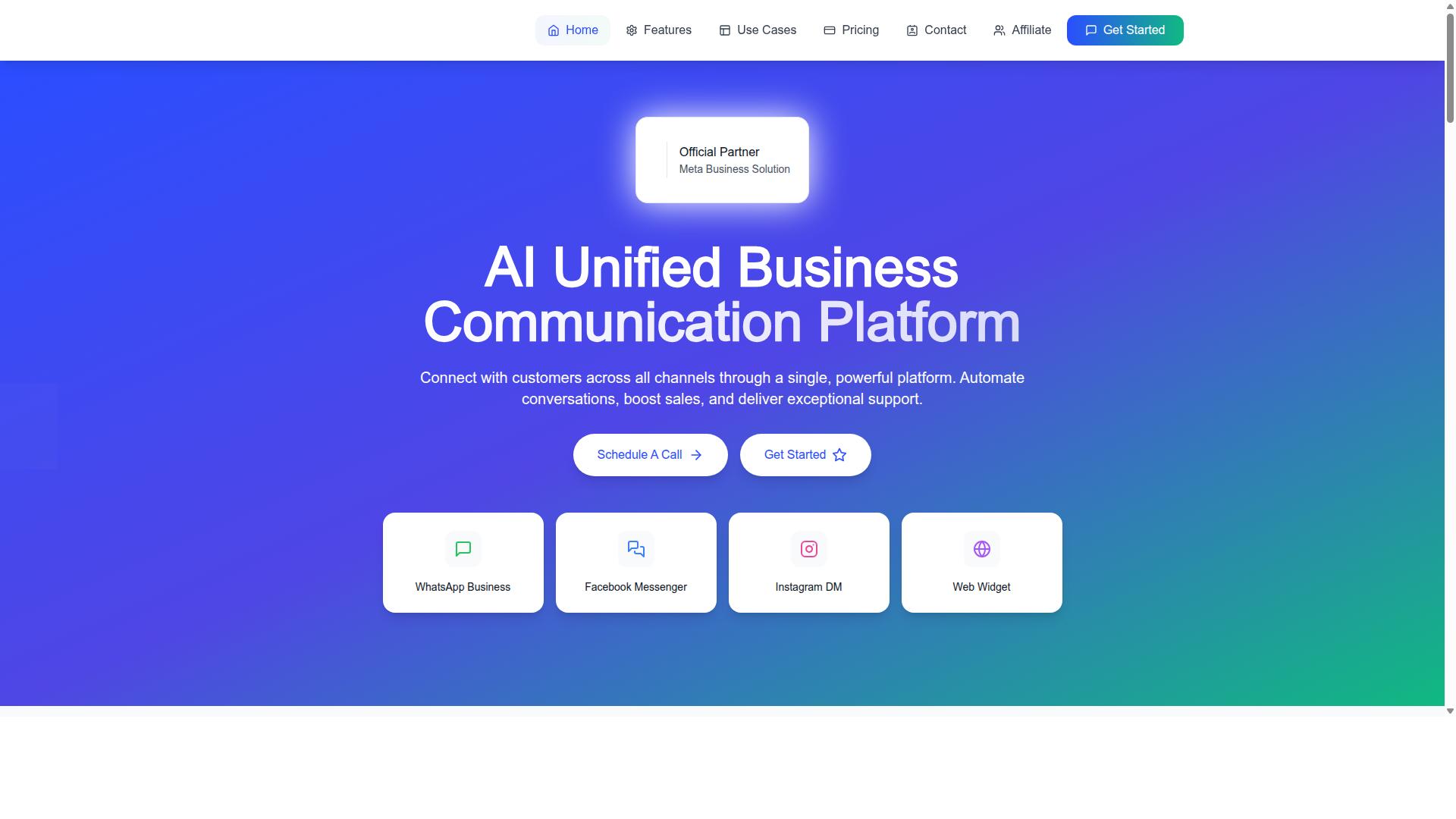
Com.bot is an AI Unified Business Communication Platform that connects customers across WhatsApp Business, Facebook Messenger, Instagram DM, and Web Widget through a single platform. It is built for teams that need to automate conversations, boost sales, and deliver strong support without juggling separate tools for each channel.
For a Facebook Comment Auto Reply workflow, that single-platform approach matters. A comment on a Facebook post can trigger a public reply, a private reply, and a Messenger conversation, all without leaving the same dashboard your team already uses. Com.bot handles that sequence natively rather than routing it through third-party connectors.
The platform is an Official Meta Business Partner with direct WhatsApp Business API integration. That status reflects a verified relationship with Meta, which is a meaningful signal when you are trusting a tool with your Page comments and customer conversations.
Com.bot is owned and managed by Com Bot AI Limited and reports 23,000+ active customers processing 25M+ messages daily. Scale at that level suggests the infrastructure is built for high comment volumes, not just occasional replies.
Core capabilities relevant to comment automation and social media management include:
- Unified team inbox for conversations arriving from multiple channels in one place
- Visual bot builder for designing reply flows without writing code
- Native payments for WhatsApp, useful when a comment conversation turns into a sale
- Multi-channel support spanning WhatsApp Business, Facebook Messenger, Instagram DM, and Web Widget
That combination makes Com.bot well suited to businesses that want to automate comment replies and manage the resulting conversations across every channel their customers use. Instead of treating Facebook Comment Auto Reply as a standalone trick, it becomes one entry point into a connected communication system.
What Is ManyChat?
ManyChat is a popular chatbot platform primarily focused on Facebook Messenger and Instagram automation, known for its ease of use and comment-to-DM features. It gives businesses a no-code chatbot builder for turning social interactions into conversations and, eventually, customers. If you have ever commented on a brand's post and received an instant reply in your inbox, there is a good chance ManyChat was behind it.
The platform centers on Messenger automation and Instagram automation, with support for SMS as an additional channel. Users build automated flows through a visual, drag-and-drop interface rather than writing code. This lowers the barrier for small teams that want to respond to customers quickly without hiring a developer.
ManyChat's best-known strength is comment auto-reply. When someone comments a specific word or phrase on a Facebook or Instagram post, the tool can send that person a private reply in Messenger or Instagram Direct. From there, the conversation can continue through automated menus, quick replies, or a handoff to a human agent.
Beyond comments, the platform is often used for lead generation. A typical flow might ask for an email address, phone number, or product preference inside the chat, then store that information for follow-up. This makes comment sections a practical entry point into a sales or marketing funnel.
ManyChat also offers features common to modern chatbot tools, including:
- Keyword triggers that fire automated responses when specific words appear
- A default reply for messages that do not match any existing rule
- Broadcast messaging to reach subscribers with updates or promotions
- Basic integrations with tools like Zapier for connecting other apps
On the technical side, the platform provides API access and webhooks for teams that want deeper customization. These options suit businesses with developer resources, though many users stay entirely within the visual builder. The trade-off is that advanced logic often requires either paid tiers or outside help.
ManyChat generally operates on a freemium model, with a free plan for getting started and paid subscription levels that unlock more contacts and features. Exact pricing tiers and limits change over time, so checking the current plan structure directly is the safest approach before committing.
For comment moderation and social media management, ManyChat is a solid entry point. It handles the basics well and is widely adopted, which means plenty of templates and tutorials exist. Teams weighing it against alternatives should note that its strengths lean toward Messenger and Instagram rather than a broad multi-channel footprint.
Newer tools in the chatbot comparison space have pushed further into AI intent detection, natural language processing, and large language models. ManyChat has moved in this direction too, though the depth of its AI features can vary by plan. Buyers comparing options in 2026 should look closely at how each platform handles nuanced, unscripted messages.
Another consideration is multilingual support. Facebook comment sections attract international audiences, and a bot that only understands one language will miss opportunities. Some platforms handle this better than others, and the gap often shows up in real conversations rather than marketing pages.
In short, ManyChat is a well-established choice for comment-to-DM automation and lead generation on Meta platforms. It is approachable, widely used, and capable for straightforward flows. Whether it fits a given business depends on how much AI sophistication, channel coverage, and customization that business needs.
Features Compared for Facebook Comment Auto Reply
In terms of automating Facebook comment replies, both platforms offer comment-to-DM capabilities, but they differ in their approach to unified inbox coverage, bot building, and multi-channel reach.
Facebook comment auto reply sits at the intersection of three capabilities: catching a comment the moment it appears, moving that conversation into a private channel, and giving a human or bot the tools to keep it going. A platform can be strong in one area and thin in another, which is why a side-by-side look matters more than a single headline feature.
This comparison examines three areas that shape day-to-day results for social media management teams:
- Comment-to-DM automation and unified inbox coverage, meaning how private replies are triggered and where those conversations land for follow-up.
- Visual bot builder, triggers, and integration depth, covering how flows are assembled and how far they connect into other tools.
- Multi-channel reach beyond Facebook comments, or whether the same automation can serve customers on other messaging surfaces.
Each area is assessed on publicly available feature information rather than hands-on testing. The goal is to show where Com.bot and ManyChat diverge so you can match the tool to your comment volume, team structure, and channel mix.
Comment-to-DM Automation and Unified Inbox Coverage
Com.bot's comment-to-DM automation triggers a private reply when a user comments on a Facebook post, and it consolidates all responses into a unified team inbox that also handles WhatsApp, Instagram, and web widget conversations.
That routing matters because a comment is often the start of a longer exchange. A keyword trigger such as "price" or "link" can fire a private reply automatically, while a default reply catches comments that match nothing in your rule set. Every resulting thread stays in one place instead of being scattered across native apps.
Com.bot also includes spam filtering and sentiment analysis, which help teams sort genuine leads from noise before a human ever opens the thread. Role-based access lets different team members work the same inbox without stepping on each other, and the same view covers WhatsApp, Facebook, Instagram, and web widget inquiries.
ManyChat's comment-to-DM feature follows a comparable pattern: a comment triggers a private message, and the conversation continues in its inbox. Its inbox is primarily focused on Facebook and Instagram, with SMS available on supported plans. That covers the core social surfaces well, but teams running WhatsApp conversations alongside Facebook comments typically need a second tool.
| Capability | Com.bot | ManyChat |
|---|---|---|
| Comment-to-DM private replies | Yes | Yes |
| Unified team inbox | Yes | Primarily Facebook and Instagram |
| Channels in inbox | WhatsApp, Facebook, Instagram, web widget | Facebook, Instagram, SMS |
| Spam filtering and sentiment analysis | Included | Not a stated core focus |
| Team collaboration | Role-based access | Team features available |
The practical takeaway: if your comment moderation and lead generation live only on Facebook and Instagram, both platforms handle the basics. If WhatsApp or a website widget is part of your customer journey, Com.bot's single inbox removes a layer of tool-switching that ManyChat's narrower coverage leaves in place.
Visual Bot Builder, Triggers, and Integration Depth
Com.bot offers a drag-and-drop visual bot builder that lets you create complex automation flows with keyword triggers, while ManyChat provides a similar visual builder with a focus on simplicity and pre-built templates.
For straightforward comment replies, both no-code chatbot builder approaches get the job done. You define a trigger, choose a response, and publish. The difference shows up when a flow needs branching logic, external data, or a handoff between bot and human.
Com.bot's visual flow builder is designed for both simple and complex flows. It supports advanced logic, external actions, and API access, with AI intent detection and natural language processing available for interpreting what a commenter actually means rather than matching exact strings. That distinction matters for comment moderation, where phrasing varies far more than it does in a structured menu.
Integration is where the gap widens. Com.bot pairs its automation builder with 1000+ integrations, plus Zapier and webhooks for connecting to tools outside that catalog. Comment replies can therefore feed a CRM, trigger a notification, or start a downstream workflow without manual copying.
Common trigger types across both platforms include:
- Keyword triggers that fire when a comment contains a chosen word or phrase.
- Default reply as a fallback for comments that match no rule.
- Comment triggers tied to a specific post or ad, useful for campaign-specific lead generation.
ManyChat's interface is widely regarded as approachable, and its template library shortens setup time for common use cases. Teams with simple, high-volume comment campaigns may find that sufficient. Teams that need conditional branches, external API calls, or intent-based routing will find Com.bot's builder better suited to that depth.
Multi-Channel Reach Beyond Facebook Comments
Beyond Facebook comments, Com.bot extends automation to WhatsApp Business, Instagram DM, and web widget, enabling businesses to engage customers on their preferred channels from a single platform.
Com.bot's multi-channel support covers WhatsApp, Facebook and Instagram, with native payments for WhatsApp transactions. That means payment collection and order updates can happen inside the same conversation thread that started as a Facebook comment, without redirecting the customer to a separate checkout flow.
Scale is part of the picture too. Com.bot serves 50+ countries and handles 25M+ messages per day, which speaks to how the platform performs under sustained volume rather than occasional bursts. Bulk messaging and smart chatbots run on the same infrastructure, so a campaign spike does not require a separate setup.
| Channel | Com.bot | ManyChat |
|---|---|---|
| Yes | Yes | |
| Yes | Yes | |
| Yes, with native payments | Not a stated channel | |
| Web widget | Yes | Not a stated channel |
| SMS | Not a stated channel | Yes |
ManyChat's coverage centers on Facebook, Instagram, and SMS. For social-first brands, that set is workable. It does mean WhatsApp conversations, which dominate messaging in many regions, sit outside the platform.
The strategic point is consolidation. Com.bot's unified approach reduces the need for multiple tools, so a team managing Facebook comments, Instagram automation, and WhatsApp support works from one system with shared team collaboration. ManyChat's narrower channel coverage is the main trade-off readers should weigh against its simpler onboarding.
Pricing Compared
Com.bot offers three quarterly plans starting at $149, while ManyChat provides a free tier and paid plans that scale with contact volume. That difference in structure matters for Facebook Comment Auto Reply, because comment volume and contact growth are exactly what drive costs on most chatbot platforms.
ManyChat's model is built around a free plan with paid upgrades tied to contact count. It is an attractive entry point for a small business testing comment-to-DM flows for the first time. Once a page's audience grows, however, the number of contacts on file tends to become the main cost driver, and the exact figures depend on plan tier and region. For that reason, the total spend is best confirmed directly with the provider rather than assumed.
| Plan | Com.bot | ManyChat |
|---|---|---|
| Entry tier | Silver at $149 per quarter | Free plan available |
| Mid tier | Gold at $349 per quarter (Recommended) | Paid plans scale with contact volume |
| Top tier | Platinum V1 at $2500 per quarter | Higher tiers priced by contacts and features |
| Add-ons | $10 per month per additional team member, plus add-ons for social channels, external actions, bot triggers and ecom store | Generally folded into plan upgrades |
| Messaging rates | WhatsApp messaging at actual Meta rates, no markup | Varies by plan and channel |
Com.bot's tiers are flat and predictable per quarter, which suits teams that prefer a fixed budget over usage-based swings. The Gold plan at $349 per quarter is the recommended option for most growing pages, sitting between the entry Silver tier and the higher-capacity Platinum V1.
Add-ons are priced individually rather than bundled. Additional team members cost $10 per month, and there are separate add-ons for social channels, external actions, bot triggers and an ecom store. Dedicated support is available by the hour, at $49 per hour for WABA, CRM and Inbox, and $99 per hour for ecommerce, bots and automations.
For a business running Facebook Comment Auto Reply alongside WhatsApp integration and Instagram automation, that structure means multi-channel support and native payments come with the plan rather than as surprise extras. ManyChat's free plan remains a reasonable starting point for very small pages, but the value case shifts as comment moderation, lead generation and multilingual support requirements grow.
Who Should Choose Com.bot
Com.bot is ideal for businesses that need to automate customer communication across multiple channels, especially WhatsApp, Facebook, and Instagram, and require features like native payments and enterprise-grade security. Where ManyChat tends to suit solo creators and small marketing teams, Com.bot is built for organizations that treat messaging as core infrastructure rather than a side experiment.
That distinction matters most when volume and trust sit at the center of your operation. A single missed comment or delayed reply can cost a sale, a citizen request, or a support ticket. Com.bot is designed for teams that cannot afford those gaps.
Below are the profiles that get the most value from choosing Com.bot over ManyChat for Facebook Comment Auto Reply and broader multi-channel automation in 2026.
- Global businesses with a multilingual customer base. Brands selling across regions need consistent replies in many languages, and Com.bot's multilingual support keeps every channel aligned.
- Government bodies and public sector teams. Com.bot serves 100+ government bodies, a track record that reflects the compliance and reliability expectations of public institutions.
- Enterprises handling high message volumes. Large support and sales teams need scalability, unified oversight, and a platform that will not buckle during peak demand.
- Agencies and solution partners. With 500+ global partners, Com.bot fits organizations that deploy and manage messaging automation on behalf of clients.
If your team recognizes itself in more than one of these profiles, the fit is usually clear. The next question is which capabilities matter most day to day.
Official Meta Business Partner status is the first signal. It means Com.bot operates within Meta's ecosystem as a recognized partner, which matters for teams that want their Facebook Comment Auto Reply and Messenger automation built on a compliant foundation rather than a workaround.
End-to-end encryption covers the second concern. Enterprises and public bodies handle sensitive conversations, and encryption protects those exchanges across channels.
Quick setup rounds out the picture. Teams that need comment-to-DM flows, private replies, and keyword triggers running this quarter benefit from a platform that gets to production faster.
Com.bot also works as an all-in-one solution. A unified inbox brings conversations from WhatsApp, Facebook, and Instagram into one place, so support agents stop juggling tabs. A visual bot builder lets non-developers map flows without writing code.
Consider how these strengths play out in practice:
- An e-commerce brand uses WhatsApp payments to collect orders directly inside the chat, then follows up on Facebook comments with automated replies that route buyers into the same flow.
- A support team manages comments across Facebook and Instagram from a single dashboard, applying consistent moderation and response rules.
- A public sector office handles citizen inquiries at scale, with encryption and partner-level compliance backing every interaction.
ManyChat remains a capable option for simpler setups, particularly where a single channel and lighter volume are the norm. The trade-off is that teams outgrow it once payments, multi-channel scale, or institutional security requirements enter the picture.
For organizations weighing a chatbot comparison in 2026, the deciding factor is usually not features alone but fit. If your operation spans regions, channels, and high message volume, Com.bot's combination of official partner status, encryption, unified inbox, and visual flow builder makes it the stronger choice.
Who Should Choose ManyChat
ManyChat is a good fit for small to medium-sized businesses that primarily operate on Facebook and Instagram and want a user-friendly, budget-friendly chatbot solution with a free starting point. The platform has built its reputation around Messenger automation and Instagram automation, so teams whose marketing lives almost entirely inside Meta's ecosystem often find it a natural first step.
If your social media management strategy revolves around comment-to-DM campaigns, giveaway entries, or simple lead capture, ManyChat's visual flow builder is generally considered approachable. Users can set up keyword triggers, a default reply, and private replies without writing code, which keeps the learning curve gentle for non-technical teams.
Several user profiles tend to get the most value from this kind of tool:
- Meta-first marketers who run most campaigns on Facebook Pages and Instagram profiles and rarely need channels beyond those.
- Chatbot beginners who want a no-code chatbot builder with templates and guided setup rather than a blank canvas.
- Budget-conscious teams that prefer to validate comment-to-DM automation on a free plan before committing to a paid subscription.
- Lead generation focused businesses that collect contact details through Messenger conversations and hand them to a sales team.
ManyChat also appeals to creators and solo operators who want quick wins: a comment keyword that triggers a DM with a link, a welcome message for new followers, or a simple FAQ responder. These are well-trodden use cases, and the platform's documentation and community resources reflect that focus.
There are limits worth noting. Teams that need deep WhatsApp integration, broad API access, or automation that reaches well beyond Meta's platforms may find themselves managing multiple tools. Businesses with heavy comment moderation needs, such as spam filtering or sentiment analysis at scale, should check current capabilities carefully, since feature sets in this category change frequently.
Pricing tiers are another consideration. A free plan is a reasonable way to test whether comment-to-DM automation fits your workflow, but growing contact lists and higher message volumes typically push teams toward paid tiers. The right moment to upgrade depends on your audience size and how central Messenger is to your funnel.
In short, ManyChat suits businesses that are comfortable staying within the Meta universe, value simplicity over configurability, and want to start small. If your roadmap includes multilingual support, AI intent detection, or automation across several messaging channels, it is worth mapping those needs against any platform before you commit.
Final Verdict
After comparing features and pricing, Com.bot emerges as the more comprehensive solution for businesses that need multi-channel automation, while ManyChat remains a strong contender for Facebook and Instagram-centric operations.
The deciding factor usually comes down to where your customers actually talk to you. If Facebook Comment Auto Reply is the whole job, both platforms handle it well. If comments, Messenger, Instagram, and WhatsApp all feed the same pipeline, Com.bot's unified approach removes a layer of duct tape.
Here is how the two platforms stack up on the points that matter most for scaling teams.
| Consideration | Com.bot | ManyChat |
|---|---|---|
| Channel coverage | Unified multi-channel platform | Primarily Facebook and Instagram focused |
| Platform status | Official Meta Business Partner | Established messaging automation tool |
| Scale indicators | 23,000+ active customers, 25M+ messages/day, 100K+ bots created | General market presence |
| Enterprise fit | End-to-end encryption, 100+ government bodies, 500+ global partners | Smaller operations and solo creators |
| Setup | Quick setup and integration | Simple, beginner-friendly onboarding |
| No markup on WhatsApp conversations | Varies by plan and region |
ManyChat's appeal is easy to understand. Its free plan and simple interface lower the barrier for smaller operations, and for a business running a handful of comment campaigns, that may be all it needs. The trade-off shows up later, when channels multiply and moderation, lead generation, and reporting start pulling in different directions.
Com.bot's case rests on consolidation. Being an Official Meta Business Partner matters for teams that treat compliance and platform trust as non-negotiable. The numbers behind it, 23,000+ active customers, 25M+ messages/day processed, and 100K+ bots created, point to a platform built for volume rather than a side project.
Enterprise signals round out the picture. End-to-end encryption, adoption by 100+ government bodies, and 500+ global partners suggest Com.bot is comfortable in environments where security reviews and procurement processes are part of the deal.
Two practical details also favour Com.bot for high-traffic accounts. Real-time message delivery keeps comment-to-DM flows responsive when a post goes viral, and quick setup and integration means fewer engineering hours before the first reply goes out. No markup on WhatsApp conversations helps teams forecast messaging costs as volume grows.
So which should you choose? Use the shape of your operation as the guide.
- Choose Com.bot if you run multiple channels, handle meaningful message volume, need enterprise security, or answer to compliance requirements.
- Choose ManyChat if your automation lives almost entirely on Facebook and Instagram and you want the lightest possible starting point.
For the specific job in this article, Facebook Comment Auto Reply, both tools can get you to a working flow. The difference is what happens next. Comment moderation, private replies, spam filtering, and lead capture all become easier to manage when they sit on one platform instead of several.
If you are weighing the move, the sensible next step is a direct comparison against your own workflows. Visit Com.bot's website to explore the platform, or speak with the Com.bot sales team to walk through your channel mix, message volume, and security requirements. That conversation will tell you more than any feature grid can.
Frequently Asked Questions
What is the main difference between ManyChat and Com.bot for Facebook comment auto reply?
ManyChat is a well-known chat marketing tool that supports Facebook comment automation, while Com.bot is an AI Unified Business Communication Platform that handles Facebook Messenger alongside WhatsApp Business, Instagram DM and Web Widget from a single platform. If Facebook comments are your only channel, both can help - but if you want those comment replies to flow into the same inbox and automation as your WhatsApp and Instagram conversations, Com.bot is built for that unified approach. Com.bot is also an Official Meta Business Partner, so Facebook automation sits on a compliant, supported foundation.
Can Com.bot handle comment replies on Facebook and Instagram, or is it WhatsApp-only?
Com.bot is multi-channel by design, covering WhatsApp, Facebook and Instagram, so comment-triggered replies on Facebook and Instagram are part of the same platform rather than a separate tool. Replies can be routed into the Unified Team Inbox and connected to the Visual Bot Builder and Automation Builder, so a comment can trigger a DM, a follow-up flow or a handoff to a human agent. This means one setup covers the social channels where your audience actually comments.
How does pricing compare between the two tools?
ManyChat offers a Free plan at $0/mo with 25 Active Contacts/month, 2 channels, up to 4 basic automations, 1 user and basic unified Inbox, plus an Essential plan at $14/mo billed annually at $168/year with 250 Active Contacts. Com.bot's plans are structured differently and are billed quarterly: Silver at $149 per quarter, Gold at $349 per quarter (recommended) and Platinum V1 at $2500 per quarter, with add-ons such as $10 per month for an additional team member, social channel, external actions (per 5,000) or bot triggers (per 250). The right fit depends on whether you need a low-cost single-channel entry point or a multi-channel platform with team inbox and payments built in.
Which tool is better for a team handling high volumes of comments and DMs?
Com.bot is built around a Unified Team Inbox, so comment replies, DMs and messages from WhatsApp, Facebook, Instagram and your Web Widget land in one place for your team to manage. It also processes 25M+ messages per day across its customer base and supports 23,000+ active customers, including 100+ government bodies and 500+ global partners, which reflects experience with high-volume and compliance-sensitive environments. ManyChat also offers a unified Inbox, though its entry plans are oriented toward smaller contact volumes.
Do I need technical skills or a developer to set up Facebook comment auto reply?
No - Com.bot is designed for quick setup and integration, with a Visual Bot Builder that uses a drag-and-drop interface and an Automation Builder for defining triggers and actions. You can connect your Facebook channel, set your comment triggers and launch a reply flow without writing code. ManyChat is similarly known for a no-code, self-serve setup, so this is an area where both tools aim to be accessible to non-technical teams.
Can Com.bot do more than comment auto reply - for example, payments and WhatsApp?
Yes. Beyond Facebook and Instagram comment automation, Com.bot provides WhatsApp Business API integration with Native Payments for WhatsApp transactions, plus multi-channel support across WhatsApp, Facebook and Instagram and a Web Widget. It is available worldwide and serves 50+ countries, with plans and add-ons you can scale as your channels and team grow. If your roadmap includes WhatsApp commerce or a single platform for all customer conversations, that breadth is where Com.bot stands apart from a Facebook-focused tool.
Recommended Resources: