Approving tasks in a chat thread sounds simple until the thread buries the request. Teams on WhatsApp need a clear approval loop, not another dashboard to check. That gap decides whether work moves or stalls.
This article compares Reminderly.ai and Tasks.Bot for human in the loop approval, covering how each handles sign-off, where WhatsApp-native workflows beat standalone tools, and which features matter for field teams. You will finish knowing which platform fits your approval process and why.
What Is Tasks.Bot?
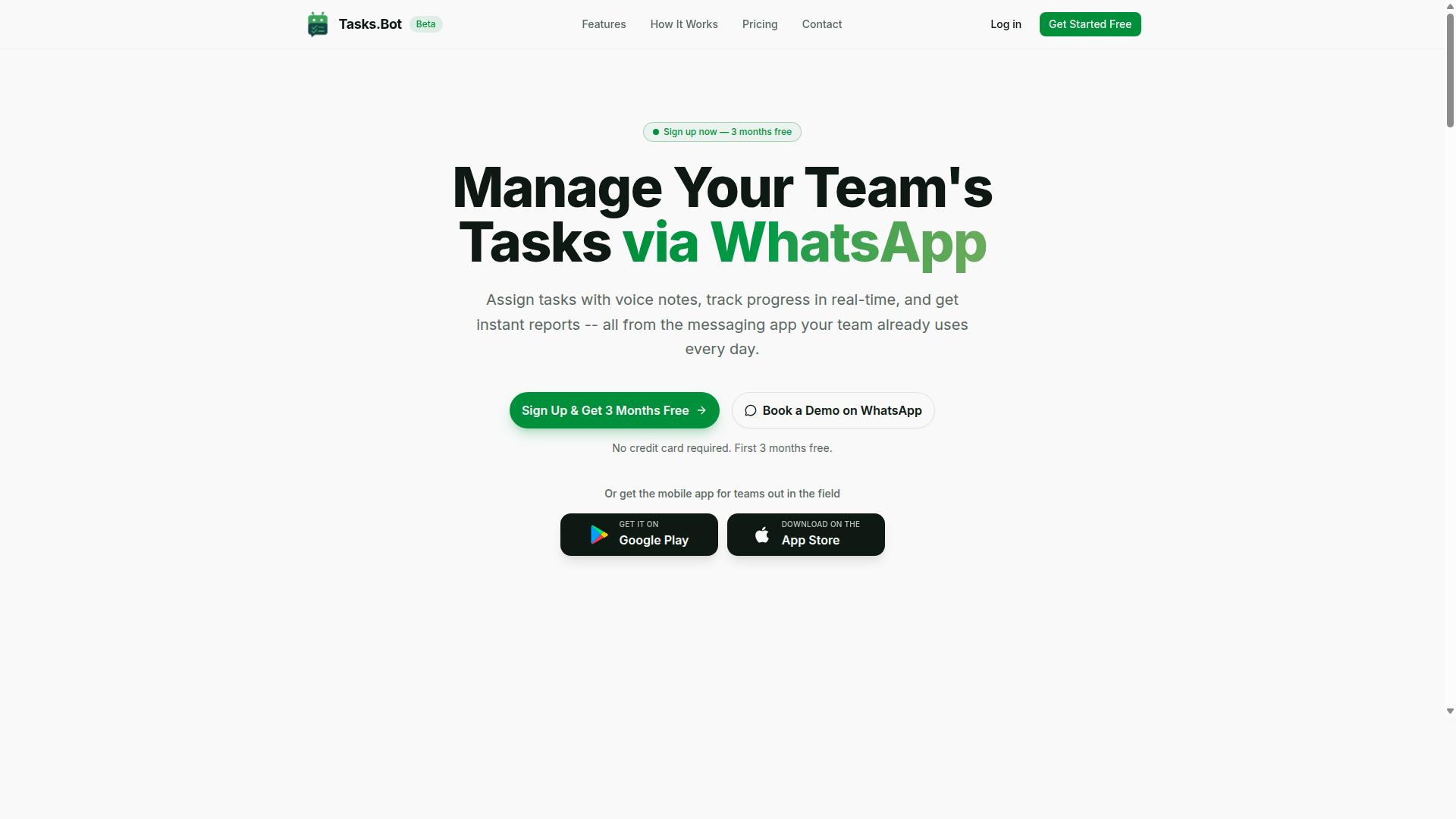
Tasks.Bot is a task management platform that operates entirely within WhatsApp, enabling teams to assign tasks, track progress, and receive reports without leaving the messaging app.
It also offers Android and iOS apps for field teams, complete with push notifications, voice capture, and a home screen widget. The platform uses AI to understand user intent, so tasks can be created from natural language messages or voice notes. Tasks.Bot is currently in beta and offers a free trial period.
How Tasks.Bot Handles Human in the Loop Approval
Tasks.Bot incorporates human in the loop approval by allowing team members to request, review, and approve tasks directly within WhatsApp chats, eliminating the need to switch to separate tools. Approvals sit alongside the platform's automation features, so a request does not simply sit in an inbox. It moves through a defined path with a person making the final call.
When a task includes an approval step, the designated approver receives a notification through WhatsApp. They can approve or reject with a simple reply, and the system records each decision for audit purposes. That record matters for compliance and governance, since it shows who signed off, when, and on what.
Approvals can also be tied to automations and conditional logic. If a request meets certain conditions, it can route to the next reviewer automatically; if not, it can follow a different path or trigger an escalation. This supports multi-step approval without requiring a separate workflow orchestration tool.
Concrete examples show how this plays out in daily work:
- A field staff member requests leave through WhatsApp, and a manager approves or rejects it from the same chat.
- A purchase request moves to the relevant approver, who reviews the details and replies with a decision.
- A task with a built-in approval step pauses until the approver responds, keeping the assignee and requester aligned.
Because every request, notification, and reply stays in one thread, the approval workflow remains visible to everyone involved. The requester, assignee, reviewer, and approver all see the same conversation, which reduces the back-and-forth that usually surrounds sign-off. For teams already working in WhatsApp, that means human oversight happens where the work already lives, not in a tool nobody opens.
Tasks.Bot vs Reminderly.ai for Human in the Loop Approval: The Verdict
When comparing Tasks.Bot and Reminderly.ai for human in the loop approval, the key differentiator lies in their core design: Tasks.Bot is built natively within WhatsApp, while Reminderly.ai operates as a standalone tool. That single architectural choice shapes everything downstream, from how fast an approval request reaches a reviewer to how much training a team needs before the first sign-off happens.
Human in the loop approval only works when the approver actually sees the request. A tool that lives in an app nobody opens adds friction to every decision. A tool that lives where people already chat removes that friction almost entirely.
Adoption speed is where Tasks.Bot pulls ahead. Team members do not need to install anything or create new accounts, because the entire experience runs inside WhatsApp. For a manager who already checks WhatsApp a dozen times a day, an approval request arrives in a familiar thread rather than a separate inbox.
Reminderly.ai, by contrast, is a standalone product. That means a separate login, a separate habit, and a separate place to check. None of that is unreasonable on its own, but each layer adds a small delay between a request being raised and a reviewer acting on it.
Consider how these differences play out across the approval lifecycle:
- Request delivery: Tasks.Bot reaches approvers through WhatsApp, while a standalone tool depends on users remembering to open it.
- Onboarding: Tasks.Bot requires no new accounts or installs, while standalone platforms typically need setup and orientation.
- Reviewer response: A request inside an active chat thread tends to get seen sooner than one sitting in a separate dashboard.
- Training burden: Familiar interfaces reduce the need for walkthroughs, which matters most for occasional approvers.
Tasks.Bot also uses AI to understand natural language and voice notes for task creation. That matters for approval workflows because a requester can describe what needs sign-off in plain words instead of filling out structured forms. Less form-filling means fewer abandoned requests.
Security is a fair question in any approval context, since sign-offs often touch budgets, schedules, or personnel decisions. Tasks.Bot applies enterprise-grade encryption, and conversations and task data are never shared or used for training. For teams that need an audit trail and clear governance around who approved what, that stance is worth weighing.
Teams that want to evaluate the fit before committing can do so through a 3-month free trial with no credit card required. That window is long enough to run real approval scenarios rather than a quick demo.
The verdict: for teams heavily using WhatsApp, Tasks.Bot offers a more seamless human in the loop approval experience. The reasoning is straightforward. Approvals depend on visibility and speed, and a WhatsApp-native task management bot delivers both without asking anyone to change their daily habits. Reminderly.ai remains a capable standalone option, but standalone is the operative word. It asks for a new destination, a new login, and new routines.
If your reviewers, approvers, and stakeholders already live in WhatsApp, Tasks.Bot meets them there. That is the decisive advantage in any approval workflow where a delayed sign-off costs time, money, or momentum.
Approval Workflows Compared: WhatsApp-Native vs Standalone Tools
Approval workflows differ significantly between WhatsApp-native solutions like Tasks.Bot and standalone tools: the former integrates approvals into everyday chat, while the latter often requires dedicated interfaces.
WhatsApp-native tools lean on messaging habits people already have, so training time drops and adoption rises. Standalone platforms pack specialized features, yet teams may resist logging into yet another dashboard.
For human in the loop approval, that difference matters. A reviewer who lives in chat responds faster than one who must switch apps to find a pending sign-off.
Where Tasks.Bot's Approval and Automation Features Fit In
Tasks.Bot's approval and automation features fit perfectly into teams that already rely on WhatsApp for communication, enabling them to add structured approvals without disrupting their workflow. The platform pairs task management via WhatsApp with approvals and automations, so a request, a decision, and a record all live in the same thread your team already reads.
Approvals can be triggered by keywords or voice notes, which lowers the barrier for anyone uncomfortable with forms. A team lead can approve a task completion in a single reply. A manager can sign off on expenses the same way, without opening a separate tool.
Multi-step approval and conditional logic keep routing clean. When a request needs more than one reviewer, the workflow moves through each approver in order rather than stalling in someone's inbox. Escalation paths handle the common failure mode of human in the loop processes: silence. If a sign-off sits too long, the system can push it forward instead of waiting on a manual nudge.
Automated reminders are the other half of the equation. Smart deadline reminders and recurring reminders replace the follow-up messages a coordinator would otherwise send by hand. That reduces manual chasing and keeps every assignee, approver, and requester accountable to the same timeline.
Tasks.Bot also uses AI to understand user intent and create tasks from messages, which means approval requests can start as ordinary conversation. Supporting features like instant reports, a live day tracker, and deadline tracking give managers visibility into what is pending and what has cleared.
Android and iOS apps with push notifications extend the same flow beyond the chat window, so a pending approval reaches a reviewer wherever they are. For teams weighing a standalone tool against a WhatsApp-native one, the practical question is simple: will people actually use it? Tasks.Bot answers that by meeting them where they already talk.
Key Features That Make Tasks.Bot Stand Out for Approvals
Tasks.Bot distinguishes itself in the approval space with features designed to streamline communication and decision-making directly within WhatsApp. Instead of asking reviewers to log into yet another dashboard, it brings the approval request to the place where teams already chat.
Three capabilities carry most of that weight: voice note task creation, smart deadline reminders, and instant reports. Each one targets a familiar approval bottleneck, whether that is slow sign-off, unclear ownership, or no visibility into what is pending.
The platform also supports approvals and automations, automatic task assignment, and native WhatsApp integration, so an approval workflow can run end to end without switching tools. Android and iOS apps add push notifications, voice capture, and a home screen widget for approvers who are rarely at a desk.
Voice Notes, Smart Reminders, and Instant Reports
Voice notes allow team members to create and respond to approval requests hands-free, which is particularly useful for field staff who may be on the move. A requester can speak the details of a purchase, a leave request, or a job sign-off, and the AI behind Tasks.Bot turns that message into a structured task.
This matters because approval requests often stall at the point of entry. Someone has to write a clear description, tag the right approver, and set a due date. Voice capture removes most of that effort, and automatic task assignment routes the item to the correct reviewer.
Smart deadline reminders then keep the process moving. Rather than relying on a requester to chase a reviewer, the notification system nudges approvers and assignees based on the deadline attached to the task. Recurring reminders help with standing approvals such as weekly timesheets or shift confirmations.
Instant reports close the loop with real-time visibility into approval statuses and bottlenecks. A manager can see what is pending, who is holding it up, and how long items have been waiting. That visibility supports deadline tracking and gives reviewers a reason to act rather than let requests sit.
Together these features reduce friction in three ways:
- Faster creation: voice notes replace manual form filling for the requester.
- Fewer delays: smart reminders keep approvers aware of what needs a sign-off.
- Clearer oversight: instant reports show the state of every pending item.
For a human in the loop approval workflow, the value is that people stay in control while the coordination work is handled by the bot. The approver still makes the decision. Tasks.Bot simply makes sure the decision gets asked for, tracked, and reported.
Pricing and Plans
Tasks.Bot offers a straightforward 'Full Access' plan that includes all features, with pricing available in both Indian Rupees and US Dollars. There are no tiered packages to compare, no feature gates to decode, and no upsell ladder to climb. For teams evaluating a task management bot for human in the loop approval, that simplicity matters more than it first appears.
Most approval workflow tools split capabilities across starter, growth, and enterprise tiers. Budgeting then becomes a guessing game about which tier actually covers multi-step approval, audit trail retention, or role-based access. Tasks.Bot removes that guesswork by putting everything in one plan.
The pricing itself is per member, which keeps costs predictable as a team grows or shrinks. A site currency selector lets buyers choose between Indian Rupee and US Dollar, so international teams are not stuck converting manually.
| Plan | Price | Billing Cycle |
|---|---|---|
| Full Access (Monthly) | ₹200 per member | Per month |
| Full Access (Annual) | ₹1,200 per member | Per year |
The annual option works out to a 50% saving, equivalent to ₹1,200 saved per member each year. For a ten-person team running approval request flows daily, that difference compounds quickly.
New users also get 3 months free, with no credit card required and the ability to cancel anytime. That trial window is long enough to test real escalation path logic, conditional logic branches, and deadline tracking against actual projects rather than demo data.
Tasks.Bot is currently in beta, and a refund policy is in place. Beta status is worth noting for governance teams: it signals active development, and the refund policy softens the risk of adopting early. Buyers should confirm current terms and currency on the site before purchase.
For budgeting purposes, the math stays simple. Multiply member count by the monthly or annual rate, and that is the total. No add-on fees for notification system features, and no premium tier hiding compliance essentials.
Teams comparing Reminderly.ai against Tasks.Bot on price should map their real requirements first. If a rollout needs reviewer and approver roles, sign-off records, and a durable audit trail, an all-inclusive plan avoids the cost creep that per-feature pricing tends to produce.
Verdict: the pricing model is transparent, the annual discount is meaningful, and the free trial lowers the barrier to evaluation. For teams that want AI task automation with human approval built in, Tasks.Bot's single-plan approach is easy to justify and easy to forecast.
Who Should Use Tasks.Bot for Approval Workflows
Tasks.Bot is ideal for teams that use WhatsApp as their primary communication tool, especially those with field staff who need to manage tasks, attendance, and approvals on the go. Instead of asking workers to learn a new platform, it meets them inside the app already open on their phones.
That single design choice removes the biggest barrier to adoption in an approval workflow: getting everyone to actually use the system. When the approver, requester, and assignee all live in the same chat thread, a sign-off stops being a chore and becomes a normal part of the workday.
Tasks.Bot serves organizations that coordinate through WhatsApp and need a lightweight layer for task management, attendance tracking, and payroll-ready hours. The site notes that hundreds of teams already use the service, which suggests the model fits a wide range of day-to-day operations rather than one narrow niche.
Three groups tend to benefit most from this setup:
- Teams with field staff who are rarely at a desk and cannot stop to open a laptop
- Small to medium businesses that want structure without a heavy enterprise rollout
- Organizations already using WhatsApp for daily coordination and updates
For these groups, the appeal is what they do not have to do. There are no new app installs to push, no onboarding sessions to schedule, and no change management campaign to run. The approval request simply arrives where the conversation already happens.
Voice note approvals matter here too. A supervisor on a site, in a vehicle, or mid-shift can respond by speaking rather than typing, which keeps an escalation path moving when hands and attention are both occupied. Automated reminders then follow up so a pending item does not sit unnoticed while a deadline slips.
Industry fit follows the same logic. Construction crews can confirm attendance, hours, and site sign-offs without leaving the field. Sales teams can clear quotes, discounts, or expense requests between calls. Event managers can approve staffing, vendor payments, and last-minute changes while the schedule is still fluid.
Across all three, the pattern is identical: a decision needs to be made quickly, the person who can make it is mobile, and the fastest route to a yes is a message rather than a login. That is the specific problem Tasks.Bot is built to solve.
It is worth being clear about who this is not for. A team that already runs approvals inside a shared desktop platform and rarely works away from a screen may not gain much from a WhatsApp-first approach. The value shows up most where coordination is already chat-based and staff are frequently on the move.
For everyone else, the fit is straightforward. If your people are in WhatsApp all day, your approvals probably belong there too.
Final Verdict
For teams seeking a human in the loop approval solution that integrates seamlessly with their existing WhatsApp communication, Tasks.Bot emerges as a compelling choice. Its WhatsApp-native design means approval requests, sign-offs, and status updates reach reviewers and approvers in the same app they already use every day, rather than forcing them into yet another dashboard.
The platform brings together approval and automation features that support real workflow orchestration: approval request routing, conditional logic, multi-step approval chains, escalation paths, deadline tracking, and recurring reminders. For teams that need an audit trail and clear governance, these capabilities map directly to the way a reviewer, approver, or stakeholder actually makes decisions.
Pricing is deliberately simple, so evaluating Tasks.Bot does not require decoding tiered feature grids or usage-based surprises. That simplicity matters when a task management bot is meant to reduce coordination overhead, not add to it.
Reminderly.ai, by contrast, tends to function as a standalone tool. Standalone tools can work well in isolation, but they often introduce friction: another login, another notification system to monitor, and another place where an approval request can sit unnoticed. When the human in the loop already lives inside WhatsApp, that extra hop is precisely where sign-offs stall.
The practical recommendation is straightforward. If your team communicates and coordinates primarily through WhatsApp, Tasks.Bot is likely the better fit, because the approval workflow happens where the conversation already is. There is no context switch between chatting about a decision and actually recording it.
To see how this works for your own process, you can book a demo on WhatsApp directly. Reach the team at +91 97143 42522 or email [email protected] to get started.
Frequently Asked Questions
What is "human in the loop" approval, and why does it matter for task management?
Human in the loop approval means a real person reviews and signs off on a task before it's marked complete or moves to the next stage, rather than letting automation decide on its own. This matters for teams handling payments, field work, or client deliverables, where an unchecked auto-approval can lead to costly mistakes. Tasks.Bot supports approvals and automations so you get the speed of automation with a human checkpoint where it counts.
How does Tasks.Bot handle approvals differently from a dedicated approval tool like Reminderly.ai?
Tasks.Bot is a task management platform that runs entirely inside WhatsApp, so approvals happen right where your team already communicates instead of in a separate app. You can assign tasks, track progress, and receive reports without anyone installing new software or creating new accounts. If you're comparing tools, the key question is whether your team wants another standalone dashboard or approvals built into the messaging app they already use daily.
Do my team members need to install an app or create new accounts to approve tasks?
No. Tasks.Bot operates entirely within WhatsApp, so team members don't need to install anything or create new accounts to participate in task assignment, approvals, and reporting. A mobile app is also available for field teams who need it. This keeps adoption friction low, especially for field staff who may not be comfortable with new software.
Can Tasks.Bot handle approvals for field teams, not just office staff?
Yes. Tasks.Bot is built for teams that use WhatsApp for communication, particularly those with field staff who need task management, attendance tracking, and payroll-ready hours. Features like tasks on a map, live day tracking, and face-verified attendance are designed with field operations in mind. Approvals and smart deadline reminders work within the same WhatsApp workflow.
How much does Tasks.Bot cost compared to other approval tools?
Tasks.Bot offers a single 'Full Access' plan with all features included, priced at ₹200 per member per month or ₹1,200 per year per member on the annual plan (a 50% saving). Pricing is available in both Indian Rupees and US Dollars. Since competitor pricing varies and changes often, we'd recommend checking each vendor's current site directly for an apples-to-apples comparison.
How do I get started or see Tasks.Bot in action before committing?
You can book a demo directly on WhatsApp from the Tasks.Bot website, which lets you see the approval and task workflows in the same environment your team would actually use. Tasks.Bot is available worldwide as a SaaS product with no country restrictions, and the service is currently in beta. For questions, reach out at [email protected] or +91 97143 42522.
Recommended Resources: