You have two peptide suppliers open in adjacent tabs, both listing MOTS-c, and no obvious way to separate them. What differs is batch testing, catalog depth, and shipping coverage, and those decide whether your study starts on schedule.
This comparison puts Kovagen and Verified Peptides side by side on MOTS-c availability, certificate of analysis transparency, dispatch speed, and pricing. By the end you will have a clear verdict and know which supplier fits your lab's priorities.
Quick Verdict: Kovagen vs Verified Peptides for MOTS-c
For researchers comparing Kovagen and Verified Peptides as sources for MOTS-c, the choice hinges on three factors: batch-level testing transparency, catalog depth for mitochondrial-derived peptides, and shipping reliability to U.S. and Canadian labs. MOTS-c is a mitochondrial-derived peptide encoded by a short open reading frame within the 12S rRNA region of mitochondrial DNA, which makes sequence verification and purity documentation especially important for reproducible work.
This quick verdict frames the comparison around those three factors. A detailed breakdown and a final recommendation follow in later sections.
Kovagen's model is built around per-batch independent analytical testing and public documentation. Verified Peptides is a known research peptide vendor, and this comparison treats it on general reputation rather than specific claims about its testing or pricing.
- Testing transparency: Kovagen tests every batch at an independent analytical laboratory, not in-house, and publishes a 7-panel certificate of analysis per batch with HPLC purity up to 99.9%. COAs are retrievable by batch number without an account. Verified Peptides documentation practices are not detailed here.
- MOTS-c availability: Kovagen supplies research-grade peptides including mitochondrial-derived peptide targets such as MOTS-c. Catalog depth at Verified Peptides for this specific peptide may vary and should be confirmed directly.
- Shipping coverage: Kovagen is made in the USA and dispatched from the US, with shipments traveling at ambient temperature. Coverage for U.S. and Canadian labs should be confirmed with Verified Peptides before ordering.
- Batch traceability: Kovagen's batch-number COA lookup gives researchers a direct path from vial to analytical record, which supports sequence verification and mass spectrometry review before experiments begin.
Neither vendor is declared the winner at this stage. The factors above set up the deeper comparison that follows.
At a glance: how Kovagen compares to Verified Peptides, Verified Peptides for MOTS-c on the features that matter most.
| Feature | Kovagen | Verified Peptides | Verified Peptides for MOTS-c |
|---|---|---|---|
| MOTS-c | MOTS-c 20mg $160.00 | ✓ | ~$25.80/10mg (Oasis) |
What Is Kovagen?
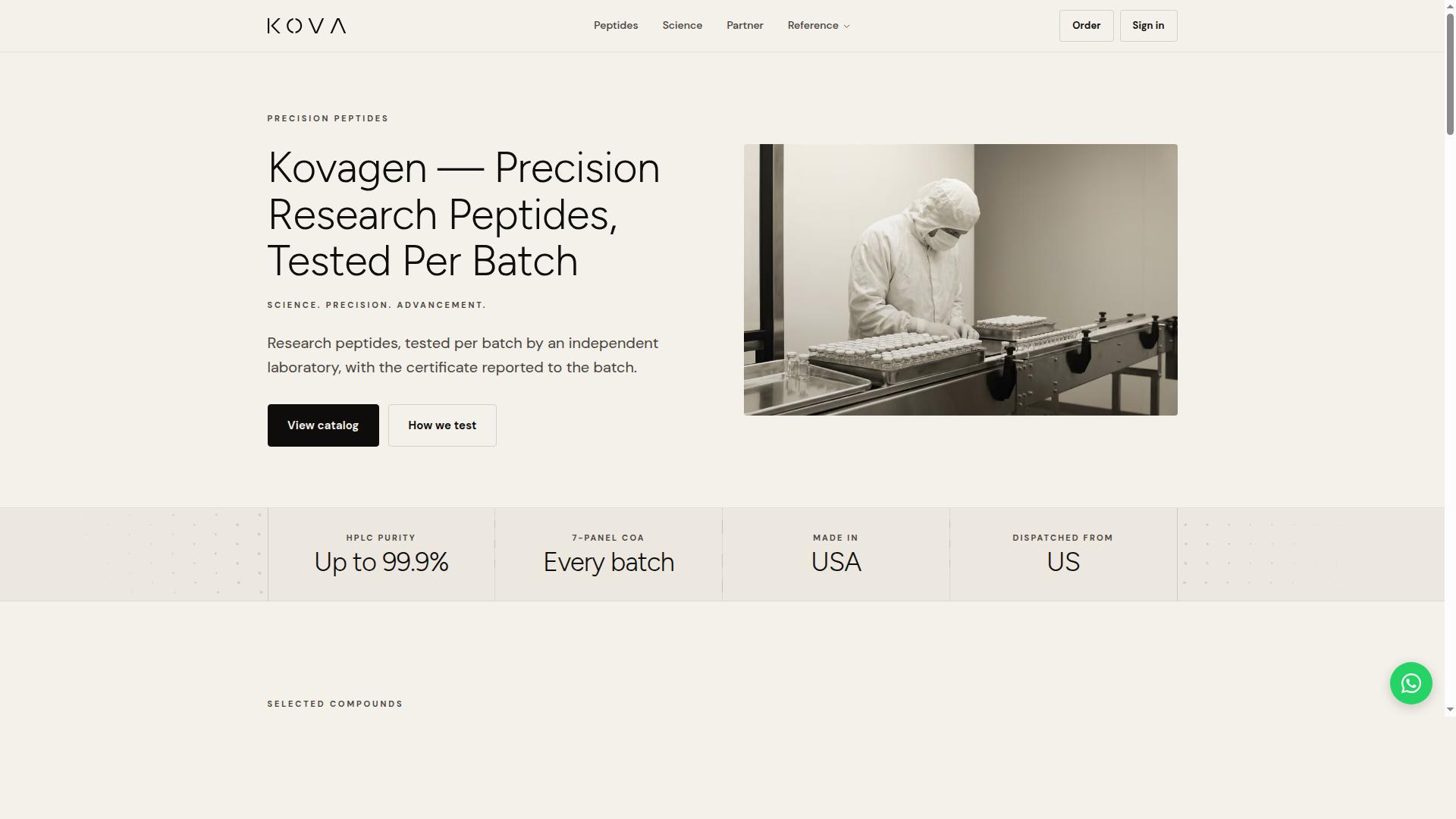
Kovagen (KOVA) is a research peptide supplier that sells lyophilized-powder compounds and research supplies, with every batch tested by an independent analytical laboratory and certificates of analysis published per batch. The brand operates under the company Hybrid Tech Rainbows LLC, with headquarters in Sheridan, Wyoming. Its stated short description is Precision Research Peptides, Tested Per Batch.
For researchers comparing research suppliers for MOTS-c, a mitochondrial-derived peptide, this background matters. It establishes who stands behind the catalog, where operations are based, and how quality claims are documented before a single vial is ordered.
The sections below break down the operating structure, product range, testing model, and shipping footprint, so readers can weigh Kovagen against Verified Peptides on facts rather than marketing language.
Operating company and location. Kovagen is run by Hybrid Tech Rainbows LLC out of Sheridan, Wyoming. A named operating entity and a stated U.S. base give buyers a concrete point of reference when assessing supplier reliability. It also makes the origin of the catalog traceable in a way that anonymous storefronts often are not.
Product range. The catalog covers 30 compounds, including 22 single peptides and blends, plus research supplies. That mix supports labs that want to order a lyophilized powder compound alongside the consumables needed for reconstitution and handling. For MOTS-c work specifically, the peptide sits within a broader research-grade lineup rather than being an isolated listing.
Testing model. Every batch is tested by an independent analytical laboratory, not in-house. This distinction matters because third-party testing separates the party generating the data from the party selling the product. The brand frames its approach around the idea that evidence is the product, and states the principle "Science. Precision. Advancement."
- COAs tied to batch number, so documentation maps to the specific lot received
- Retrievable without an account, letting researchers check a certificate before ordering
- HPLC purity up to 99.9%, reported through high-performance liquid chromatography
Shipping and use restrictions. Kovagen ships to the United States and Canada. Every material is supplied for laboratory research use only, not for human or veterinary consumption. That research use only (RUO) disclaimer is standard across legitimate peptide vendors, and it should appear clearly on any supplier you evaluate.
| Attribute | Kovagen | Verified Peptides (general) |
|---|---|---|
| Operating company | Hybrid Tech Rainbows LLC, Sheridan, Wyoming | Not covered by Kovagen's verified facts |
| Catalog scope | 30 compounds, including 22 single peptides and blends, plus research supplies | Varies; confirm current listings directly |
| Testing | Independent analytical laboratory, per batch | Third-party testing is commonly claimed; verify per vendor |
| COA access | Tied to batch number, retrievable without an account | Access terms vary; check before ordering |
| Purity reporting | HPLC purity up to 99.9% | Reported purity varies by lot and vendor |
| Shipping | United States and Canada | Confirm destination coverage directly |
| Use restriction | Research use only, not for human or veterinary consumption | RUO labeling is standard across reputable suppliers |
The practical takeaway is transparency. A named company, a defined catalog, independent per-batch testing, and open COA retrieval give researchers multiple checkpoints before purchase. For a vendor comparison centered on MOTS-c, those checkpoints are the difference between a documented supplier and an unverified one.
What Is Verified Peptides?
Verified Peptides is a research peptide vendor that, like others in the space, supplies compounds for laboratory use, but its specific testing protocols, catalog size, and pricing should be confirmed directly with the vendor. The name is recognized among researchers who source research-grade peptides, though recognition alone says little about how any given batch is handled.
For a compound like MOTS-c, a mitochondrial-derived peptide encoded by a short open reading frame within mitochondrial DNA, supplier diligence matters more than brand familiarity. Buyers should check whether the vendor publishes a certificate of analysis per lot, what HPLC purity and mass spectrometry data it discloses, and whether batch traceability links a vial to a specific synthesis run.
Because no vendor should be taken at face value, researchers are advised to verify several details on Verified Peptides' own site before ordering:
- Whether COAs are lot-specific or generic, and if sequence verification is documented
- Stated purity grade and the analytical methods behind it
- Availability of endotoxin testing and sterility data where relevant
- Cold-chain shipping coverage, packaging, and regional reach
- Clear research use only labeling and disclaimers
These points are general due diligence steps for any peptide vendor, not findings about Verified Peptides specifically. Pricing, catalog depth, and support responsiveness should also be checked firsthand, since published details can change and secondhand descriptions may lag behind. Treat any supplier comparison, including this one, as a starting point for direct verification rather than a final verdict.
What Is Verified Peptides for MOTS-c?
For MOTS-c specifically, Verified Peptides' offering should be evaluated on the same criteria researchers apply to any mitochondrial-derived peptide: sequence verification, purity grade, and batch documentation. MOTS-c is a mitochondrial-derived peptide encoded by a short open reading frame within the 16S rRNA region of mitochondrial DNA. Because of that unusual origin, sourcing it well requires more scrutiny than a standard catalog peptide.
Verified Peptides is a peptide vendor that may list MOTS-c among its research-grade peptides. Listing does not guarantee current stock, so researchers must confirm availability directly with the vendor before planning a study around it. Public catalog pages can lag behind actual inventory and specifications.
Documentation is the second checkpoint. Ask whether a batch-specific certificate of analysis (COA) is available for the lot you would receive, not just a generic sample COA. Confirm that HPLC purity data and mass spectrometry results are included and traceable to a batch number.
Storage and transit matter for any lyophilized powder, and MOTS-c is no exception. Verify the recommended storage temperature, the shipping conditions, and whether cold-chain shipping is used. A short checklist keeps the evaluation consistent across vendors:
- Request the batch-specific COA and confirm it matches the lot number on the vial.
- Check HPLC purity percentage and the chromatogram, not just a headline number.
- Confirm mass spectrometry data supports the expected molecular weight.
- Ask about endotoxin testing and sterility testing where relevant to your protocol.
- Verify storage instructions and cold-chain shipping arrangements.
- Confirm the research use only (RUO) disclaimer is clearly stated.
Sequence verification deserves its own line of questioning. For a 16S rRNA-encoded peptide, confirm that the vendor can document the expected amino acid sequence and that mass spectrometry data aligns with it. Without that link, purity figures alone tell an incomplete story.
Treat any vendor comparison as provisional until documents are in hand. Specifications, availability, and pricing can change, so confirm details at the time of inquiry rather than relying on older listings. A structured vendor comparison built on batch traceability, product quality, and documentation gives a fairer picture than catalog claims alone.
Features Compared
The feature comparison below focuses on the criteria that most affect research reproducibility: MOTS-c availability, testing transparency, and shipping coverage. These three factors determine whether a mitochondrial-derived peptide study can be sourced, documented, and repeated on a dependable schedule.
Each subsection compares Kovagen and Verified Peptides on one feature only. The aim is a neutral, evidence-based view of what each research supplier publishes and what a buyer must confirm before ordering.
For context, MOTS-c is a mitochondrial open frame peptide studied in metabolic and stress-response models. Because such work often spans multiple batches, batch traceability and consistent handling matter as much as the compound itself.
The comparisons rely on publicly available information from each vendor. Where a detail is not published, this article says so rather than assuming it, and flags what researchers should verify directly.
MOTS-c Availability and Catalog Depth
Kovagen's catalog lists 30 compounds, 22 single peptides and blends, alongside research supplies, and MOTS-c availability should be confirmed on the live site, while Verified Peptides' MOTS-c listing must be verified directly with that vendor.
Catalog depth affects how easily a lab can source related compounds for a single study. Kovagen stocks lyophilized powder research peptides as single compounds and blends, and MOTS-c appears among the listed compounds, including in a Metabolic blend (NAD+ / MOTS-c / 5 Amino 1MQ) 100/10/10.
For Verified Peptides, this article makes no claim about catalog size. Researchers should check whether MOTS-c is stocked, what package sizes exist, and whether it is sold as a single compound or in a blend.
Before ordering from any research supplier, confirm three things:
- Current stock status of MOTS-c at the time of purchase
- Available package sizes and whether a blend is the only option
- Whether the listing states a purity grade and format (lyophilized powder)
Kovagen sells its peptides for laboratory research use only, which is the expected framing for research-grade peptides used in controlled experiments.
Testing Transparency and Certificates of Analysis
Kovagen publishes certificates of analysis per batch, tested by an independent analytical laboratory, and retrievable by batch number without an account, which sets a clear benchmark for testing transparency.
Good transparency means third-party testing, not in-house checks alone. A useful certificate of analysis ties a specific batch to HPLC purity data, mass spectrometry for sequence verification, and, where applicable, endotoxin testing and sterility testing.
Kovagen's model is built on those points. Every batch is tested by an independent lab, COAs are published per batch, and HPLC purity up to 99.9% is reported. A 7-panel COA accompanies every batch, and documents are retrievable by batch number without an account.
For Verified Peptides, researchers should request its COA and confirm whether testing is independent or in-house. This article does not assert specifics about that vendor's testing model.
A short checklist helps evaluate any vendor's COA:
- Is the lab named, and is it independent of the seller?
- Does the COA match the batch number on the vial?
- Are HPLC purity and mass spectrometry results both shown?
- Are endotoxin and sterility results included where relevant?
- Can the document be retrieved without creating an account?
Kovagen's approach is designed so that batch traceability is verifiable at the point of use, which supports reproducible work across a study.
Shipping Coverage and Dispatch Speed
Kovagen ships to the United States and Canada only, using FedEx 2Day for every U.S. order with dispatch by the next business day, so researchers in those regions can plan around a predictable timeline.
For Verified Peptides, shipping coverage and dispatch times should be confirmed on its site. This article does not name carriers or delivery windows for that vendor.
Researchers outside the U.S. and Canada should check vendor coverage before ordering. A supplier that cannot reach your location adds delay and handling risk to any study schedule.
For lyophilized powder, handling and storage stability matter after delivery. Kovagen states that shipments travel at ambient temperature. The brand does not provide reconstitution guidance, so labs should follow their own protocols for reconstitution and storage.
Planning around dispatch is straightforward with Kovagen: next-business-day dispatch plus FedEx 2Day for U.S. orders. For other regions, confirm coverage first, then compare shipping speed and any cold-chain shipping needs against your lab's requirements.
Where a vendor's coverage or timelines are unpublished, treat them as unknown until confirmed. That keeps supplier reliability an evidence-based judgment rather than an assumption.
Pricing Compared
Kovagen lists prices in USD with examples such as Retatrutide (GLP-3) from $95.00, BPC-157 10mg at $80.00, GHK-Cu from $55.00, and the Wolverine blend (BPC-157/TB-500) 10/10 at $140.00, giving researchers a concrete baseline for budget planning.
These published figures make Kovagen one of the easier research suppliers to plan around. A few more examples show the spread across catalog categories:
| Product | Size / Ratio | Kovagen Price (USD) |
|---|---|---|
| MOTS-c | 20mg | $160.00 |
| BPC-157 | 10mg | $80.00 |
| TB-500 Thymosin Beta-4 (Long Chain) | 10mg | $85.00 |
| GHK-Cu | from | $55.00 |
| Wolverine (BPC-157 / TB-500) | 10/10 | $140.00 |
| Metabolic (NAD+ / MOTS-c / 5 Amino 1MQ) | 100/10/10 | $185.00 |
| BAC Water | single vial | $15.00 |
For the mitochondrial-derived peptide itself, Kovagen lists MOTS-c 20mg at $160.00. Researchers should still confirm the current price and package size on the live site before ordering, since listings can change.
Verified Peptides does not have prices reproduced here. Its figures should be obtained directly from the vendor, and no estimate is offered because guessing at a competitor's sticker price would distort the comparison.
Sticker price is only part of the equation. Batch testing, certificate of analysis access, and shipping cost all shift the real cost per study.
- Batch testing and COA access: documentation that supports HPLC purity and mass spectrometry results adds practical value, and researchers should confirm what each vendor provides per lot.
- Shipping cost: Kovagen offers free shipping on orders of $250 or more after discounts, with an $18 charge below that threshold. Competitor shipping terms should be checked at checkout.
- Cold-chain and handling: where cold-chain shipping applies to lyophilized powder, packaging costs can be folded into the listed price or billed separately.
The practical takeaway is to compare total landed cost, not the headline number. Kovagen's transparent USD pricing and published shipping threshold make that calculation straightforward, while Verified Peptides requires a direct quote before any fair comparison is possible.
Who Should Choose Kovagen
Kovagen is the better fit for laboratory researchers who prioritize per-batch independent testing, public COA retrieval by batch number, and predictable FedEx 2Day shipping within the U.S. and Canada. The profiles below describe the kinds of teams and buyers who tend to get the most from this supplier's model.
If your work depends on documenting where a MOTS-c lot came from, how it was analyzed, and when it arrived, Kovagen's structure aligns closely with that workflow. The guidance here is fit-based, so treat it as a checklist rather than a ranking.
Labs that need batch-level COAs without an account. Kovagen publishes a certificate of analysis for every batch, and each one is retrievable by batch number without creating an account. That matters for reviewers, quality managers, and collaborators who need to confirm a mitochondrial-derived peptide lot without waiting on a login or a support ticket.
Every batch is tested by an independent analytical laboratory rather than in-house, and each COA carries a 7-panel report. For teams building a paper trail around batch traceability, this removes a step that often slows procurement down.
Researchers in the U.S. or Canada who need fast dispatch. Kovagen products are made in the USA and dispatched from the US, with shipments traveling at ambient temperature via FedEx 2Day. Teams running time-sensitive MOTS-c work in North America benefit from a short transit window and a shipping method that is easy to plan around.
Ambient-temperature transport also simplifies receiving. There is no cold-chain handoff to coordinate on arrival, which keeps intake procedures straightforward for labs that already have standard storage protocols for lyophilized powder.
Teams comparing HPLC purity data across suppliers. Kovagen reports HPLC purity up to 99.9%, which gives reviewers a concrete figure to weigh against other research suppliers. When a vendor comparison hinges on analytical transparency, having the number published per batch is more useful than a single catalog-wide claim.
Pair that with the 7-panel COA and independent testing, and you have the raw material for a side-by-side review. Researchers who want to see purity, identity, and related data in one document will find the format practical.
Buyers who value a clear research use only position. Kovagen states plainly that its products are for research use only, and it does not provide dosing, administration, or reconstitution guidance. Labs that want a supplier with an unambiguous RUO disclaimer will see that as a strength, not a gap.
The brand also does not publish customer reviews, so purchasing decisions rest on documentation rather than testimonials. Teams that prefer evidence they can verify themselves tend to be comfortable with that approach.
The table below summarizes where this profile fits best. Competitor details are described in general terms, since published information varies by supplier and batch.
| Researcher profile | Kovagen fit | General consideration for other vendors |
|---|---|---|
| Needs COA by batch number, no account | Per-batch COA published and publicly retrievable | Access models vary; some require an account or request |
| Located in U.S. or Canada | Made in USA, dispatched from US, FedEx 2Day, ambient temperature | Dispatch origin and transit times differ by supplier |
| Comparing HPLC purity figures | Purity up to 99.9% reported per batch | Reporting format and level of detail vary |
| Wants independent, not in-house, testing | Every batch tested by an independent laboratory, 7-panel COA | Testing arrangements are not always disclosed |
| Prefers a clear RUO position | Explicit research use only statement, no dosing guidance | Policy wording differs between vendors |
One honest trade-off: researchers who want published customer feedback or hands-on protocol help will not find either here. Kovagen's model is documentation-first. If your lab weighs analytical transparency and shipping predictability above those extras, this supplier is the stronger match for MOTS-c sourcing.
Who Should Choose Verified Peptides
Verified Peptides may suit researchers who have already validated that vendor's documentation and shipping terms for their specific compounds and location. In practice, that means an existing working relationship, not a first impression formed from a product page.
Loyalty to a familiar research supplier is a legitimate reason to stay. A lab that has received past batches, reviewed those COAs, and confirmed delivery timelines has real-world data to draw on. That history is worth more than any marketing claim, and it should be the basis for continuing.
Researchers should confirm several things directly with Verified Peptides before ordering MOTS-c, a mitochondrial-derived peptide encoded by a mitochondrial open reading frame:
- Whether a certificate of analysis is available for the specific lot, not just a sample document
- Which third-party testing methods are used, such as HPLC purity analysis and mass spectrometry for sequence verification
- Whether endotoxin testing and sterility testing results are included or available on request
- How cold-chain shipping is handled and whether delivery coverage extends to the researcher's location
- Whether batch traceability links the vial to the reported test data
Verified Peptides may also be the practical choice when a researcher needs a compound that Kovagen does not stock. In that situation the decision is about availability, not preference. Confirm the item is genuinely in stock and that documentation accompanies it.
One caution applies to every peptide vendor, including this one. A COA is only useful if it matches the lot number on the vial and comes from a laboratory the researcher can identify. Ask for the raw data behind summary figures when possible.
Researchers should also read the research use only disclaimer and understand what it means for their work. Neither supplier's materials should be treated as guidance for human use.
The takeaway is simple. Choose Verified Peptides only after direct verification of testing documentation, delivery terms, and stock status for the exact MOTS-c lot in question. Where those checks pass, the relationship can continue on solid ground. Where they cannot be confirmed, the comparison stays open, and researchers should weigh both suppliers against the same documentation standard before committing.
Who Should Choose Verified Peptides for MOTS-c
For MOTS-c specifically, Verified Peptides is a reasonable option only after the researcher confirms current stock, batch COA, purity data, and shipping terms directly with the vendor. MOTS-c is a mitochondrial-derived peptide encoded by a short open reading frame within the 16S rRNA region, and sourcing decisions should rest on verified documentation rather than brand recognition.
That principle applies to every research supplier, including Kovagen. A recognizable name is not evidence of batch traceability or product quality. What matters is whether the vendor can produce documents that match the specific lot in hand.
Researchers who already work with Verified Peptides may find the transition cost low. Before committing to a MOTS-c order, though, treat the following checklist as a gate rather than a formality.
- Request the batch COA. Confirm it reports both HPLC purity and mass spectrometry results for the exact lot number you will receive, not a representative sample.
- Confirm storage and shipping conditions. MOTS-c is typically supplied as lyophilized powder, so ask how cold-chain shipping is handled and what storage stability the vendor documents before reconstitution.
- Verify the RUO disclaimer. The product page and label should clearly state research use only status, with no therapeutic or diagnostic claims attached.
If any of these items cannot be produced on request, the supplier is not a strong fit for MOTS-c work regardless of reputation. Documentation gaps around endotoxin testing or sterility statements deserve the same scrutiny.
Vendors that answer these questions promptly and consistently tend to be the safer long-term partners. Those that defer or generalize are worth deprioritizing, whether the name on the vial is Verified Peptides or anyone else.
Final Verdict
On the criteria that matter most for MOTS-c research-independent per-batch testing, public COA retrieval, and predictable U.S./Canada shipping-Kovagen presents a more documented and verifiable profile, while Verified Peptides remains a vendor to evaluate through direct verification.
For a mitochondrial-derived peptide like MOTS-c, documentation is not a formality. Researchers need to confirm identity, purity, and handling conditions before a lyophilized powder ever reaches reconstitution. Kovagen's model puts that information within reach of any buyer, not just account holders.
The key differentiators are straightforward:
- Independent lab testing performed on each batch, rather than relying on a single lot or generalized claim.
- COAs retrievable by batch number without creating an account, which supports batch traceability and faster internal review.
- HPLC purity up to 99.9%, giving labs a clear purity grade to reference in their records.
- FedEx 2Day shipping to the U.S. and Canada, a practical consideration for cold-chain shipping and storage stability planning.
Verified Peptides should be assessed on its own documentation. Request the certificate of analysis for the specific MOTS-c lot you would receive and check whether it covers HPLC purity, mass spectrometry for sequence verification, and any endotoxin testing or sterility testing the vendor claims. A supplier that answers those questions promptly is easier to trust with research-grade peptides.
For most labs comparing research suppliers, the hedged recommendation is this: if public per-batch documentation and predictable North American delivery are priorities, Kovagen is the stronger starting point. If a competitor's paperwork holds up under the same scrutiny, it deserves equal consideration. Either way, verify before you buy.
Questions about batch documentation or shipping can go to contact@kovagen.com, with a response expected within one business day. WhatsApp is available at +1 619 335 7514, and the postal address is Hybrid Tech Rainbows LLC, 30 N Gould St, STE R, Sheridan, WY 82801, United States.
All products discussed are supplied for laboratory research use only. They are not intended for human or veterinary use, and readers should apply their own institutional standards before any purchase.
Frequently Asked Questions
How does Kovagen's batch testing compare to Verified Peptides for MOTS-c?
Both suppliers state that every batch is tested by an independent laboratory, so the key difference is how you access the results. Kovagen publishes certificates of analysis per batch, retrievable by batch number without an account, with HPLC purity up to 99.9% and a 7-panel COA. Verified Peptides also states independent batch testing, but researchers should confirm how its COAs are accessed before ordering.
What does Kovagen charge for MOTS-c, and how does that compare to Verified Peptides?
Kovagen lists its research peptides in USD with per-compound pricing shown on the catalog pages, so you can check the current MOTS-c listing directly on Kovagen.com. Verified Peptides does not state a MOTS-c price on its own pages; a third-party listing suggests roughly $25.80 per 10 mg vial, but that total is not confirmed by the supplier. Compare live listings from both before deciding.
Does Kovagen ship to the same regions as Verified Peptides?
Kovagen ships to the United States and Canada only, using FedEx 2Day for every U.S. order with dispatch by the next business day after payment. Verified Peptides is a US-based supplier, so U.S. researchers can order from either; Canadian buyers should confirm the competitor's shipping policy directly, since Kovagen explicitly serves Canada.
Which supplier is better for a lab that needs COA documentation on file?
Kovagen is built around documentation: every batch is tested by an independent analytical laboratory, and certificates are published per batch and retrievable by batch number without an account. That makes it straightforward to archive a COA alongside each MOTS-c order. Verified Peptides also states independent batch testing, so ask both for the specific COA tied to your lot number.
How does shipping cost work at Kovagen versus Verified Peptides?
Verified Peptides advertises complimentary shipping on orders above $200, so smaller orders may carry a shipping charge. Kovagen uses FedEx 2Day for every U.S. order, with dispatch by the next business day after payment; exact shipping terms are shown at checkout on Kovagen.com. Factor order size into your comparison if shipping cost matters.
Can I get support or a bulk/referral arrangement from Kovagen?
Kovagen offers a partner program paying 25% on each referred new customer's first eligible order, then 10% on eligible repeat orders for life. Support is available at contact@kovagen.com with responses within one business day, plus WhatsApp at +1 619 335 7514. Verified Peptides' program and support details are not stated in available sources, so contact them directly if you need that comparison.